About Oncostoma cinereigulare (P.L.Sclater, 1857)
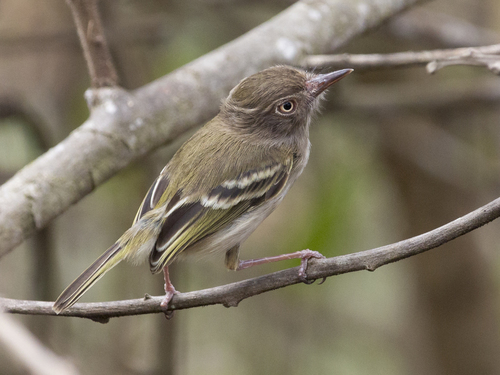
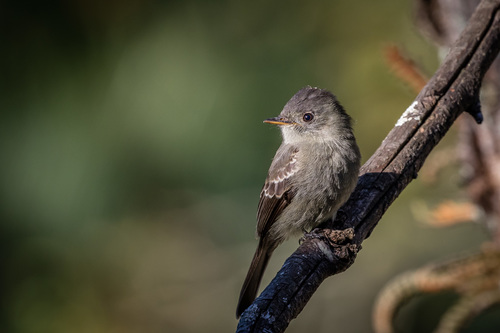
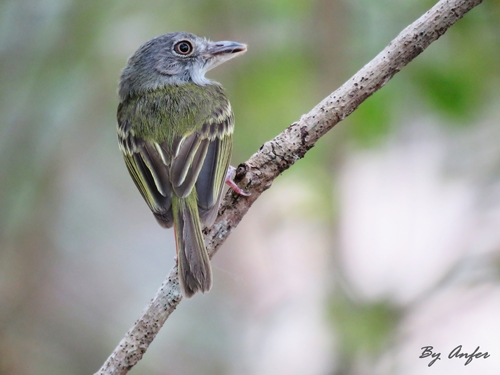
The northern bentbill, Oncostoma cinereigulare, is 9.5 to 10.5 cm (3.7 to 4.1 in) long and weighs approximately 4.5 to 7 g (0.16 to 0.25 oz). It has a distinctive, fairly thick downcurved bill. The sexes of this species share identical plumage. Adult northern bentbills have a mostly pale gray head, with a slightly darker crown. Their back, rump, and uppertail coverts are olive. Their wings are dusky, with lemon yellow edges on the flight feathers and yellow tips on the coverts; the tipped coverts form two distinct wing bars. Their tail is dusky. Their throat and breast are pale gray marked with olive streaks, while their belly is pale lemon-yellow with an olive wash on the flanks. Adults have a pale yellow iris, a gray bill with a pinkish base, and pinkish legs and feet. Juveniles differ from adults: they have an olive crown, buffy edges on flight feathers, buffy tips on wing coverts, and a dusky bill. This species is primarily distributed from southern Veracruz, northern Oaxaca, and the Yucatán Peninsula in southern Mexico, south along the Caribbean and Pacific slopes through every Central American country to western Panama. In Panama, it reaches western Colón Province on the Caribbean side and western Chiriquí Province on the Pacific side. The northern bentbill inhabits the interior and edges of humid lowland evergreen forest, semi-deciduous forest, deciduous forest, secondary woodlands, and partially open scrublands within the tropical zone. Across all these landscapes, it favors thickets and dense undergrowth. Its overall elevational range extends from sea level up to 1,500 m (4,900 ft), but it only reaches around 1,100 m (3,600 ft) in Costa Rica. One specimen collected in Colombia near the Panama border was long considered misidentified, but was later confirmed to be a northern bentbill. It remains unknown whether this individual was a vagrant, or if it represents a disjunct population of the species in Colombia.