About Oncosperma tigillarium (Jack) Ridl.
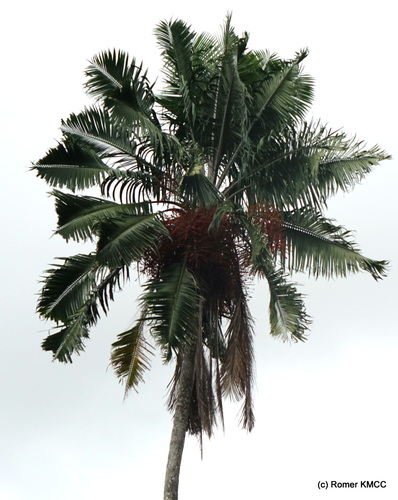
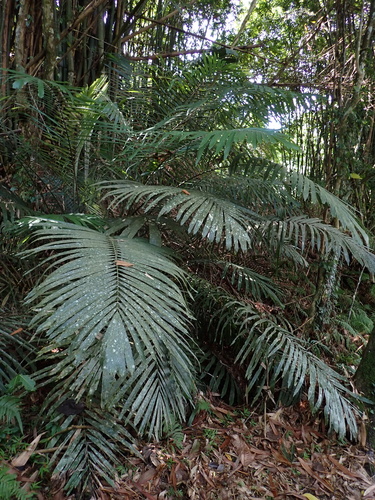
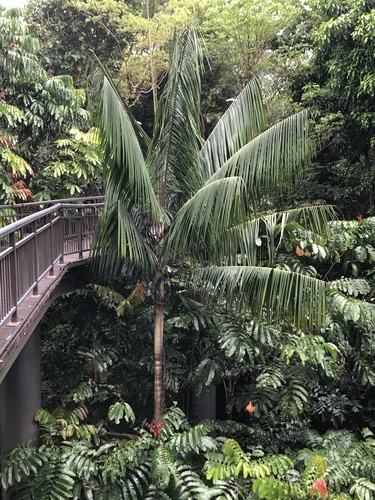
Oncosperma tigillarium (Jack) Ridl. grows between 12m and 30m tall, forming dense thickets that can contain up to 50 individual palm trees. Its trunks are covered in long black spines, and it produces finely pinnate leaves with drooping leaflets.
This species is native to Southeast Asia, found in low-salinity inland waters near mangrove swamps in southern Vietnam, Cambodia, the Philippines, Malaysia, and Indonesia. All native populations occur west of the Wallace Line, at elevations below 150 metres. It is endangered in parts of its native range due to deforestation, and has become invasive on a small number of tropical Western Hemisphere islands where it was planted as an ornamental.
In Singapore, a cluster of nibong palms (the common name for this species) survives near the entrance to the Istana at the end of Orchard Road. A plaque at this site notes that since nibong is a mangrove palm, the site must have been a mangrove swamp in the past. Oncosperma tigillarium is a close relative of Oncosperma horridum, and both species have seawater-resistant stems. This property makes the wood useful for constructing kelongs, which are wooden structures built in shallow seas to catch or cultivate fish. In Cambodia, its hard black wood is used for dam pickets, board manufacturing, and umbrella ribs. Its green fruit can be used as a replacement for areca nut in betel quid, and its leaf buds are edible.