About Omphalotus olearius (DC.) Singer
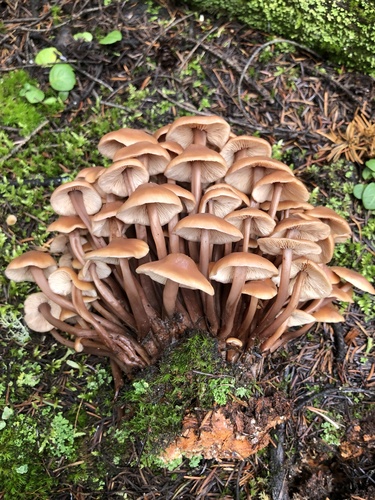
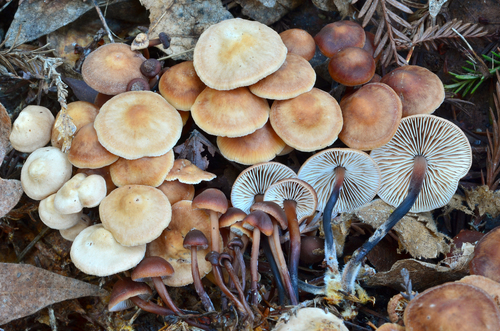
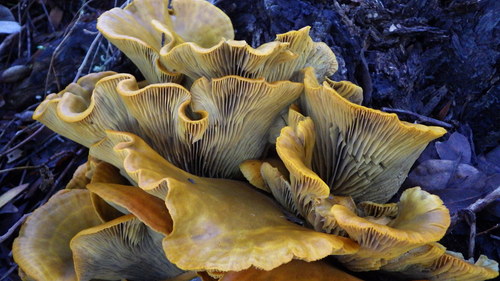
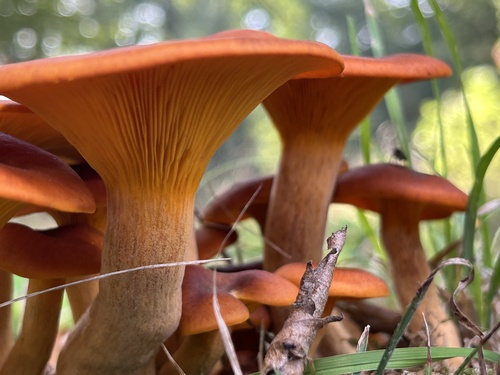
Omphalotus olearius, commonly known as the jack-o'-lantern mushroom, has the same shade of orange on its internal and external tissues. It does not change color when bruised or sliced, a trait that helps distinguish it from similar-looking species. Fresh specimens of this mushroom display blue-green bioluminescence, which is visible in low light once the human eye has become dark-adapted. The entire mushroom does not glow; only the gills produce light. This glowing effect is caused by the enzyme luciferase acting on a compound called luciferin, producing light in the same way fireflies do. While bioluminescence is known to help some fungi reproduce by attracting insects to spread their spores, the jack-o'-lantern mushroom does not use its bioluminescence to attract insects, and studies have not yet confirmed the exact function of bioluminescence in this species. Key identifying features of the jack-o'-lantern mushroom include true, sharp, decurrent, non-forking gills. It has a non-distinctive smell. Its cap ranges from 4 to 12 cm in diameter. The stem measures between 1 and 2 cm in thickness, and 3.5 to 9 cm in total length from its connection to the cap to the stem base. Omphalotus olearius is an uncommon species. It can be found during summer and fall, from July to October, in southern Europe, including southern France, the Iberian Peninsula, and other Mediterranean countries. It has also been reported from Western Cape Province, South Africa. Jack-o'-lantern mushrooms grow in clusters in deciduous forests. They prefer growing on the roots, decaying stumps, and bases of hardwoods, and are especially associated with the decaying roots of olive trees.