About Omphalotus nidiformis (Berk.) O.K.Mill.
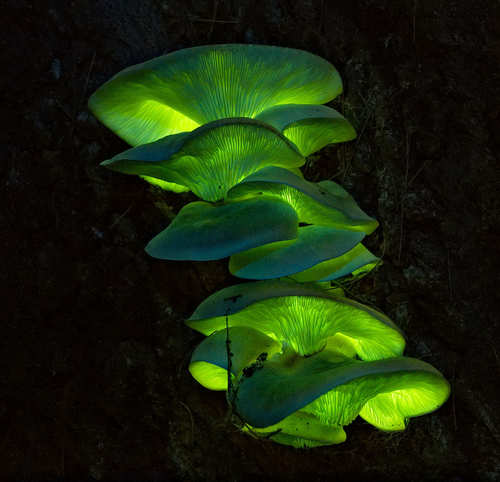
The fruit bodies of the ghost fungus Omphalotus nidiformis grow on dead or diseased wood. They may first be noticed at night as a pale whitish glow at the base of trees in eucalypt forests. The cap is highly variable in colour: it may be cream, but is often tinted with orange, brownish, greyish, purple, or even bluish-black shades. The cap margin is lighter, generally cream; brown specimens have tan or brown edges. The cap centre typically has several darker shades, and younger specimens are often darker. The cap can reach 30 cm (12 in) in diameter, is funnel or fan-shaped, and has inrolled margins. The cream-white gills are decurrent, often drip with moisture, grow up to 13 mm (0.5 in) deep, range from somewhat distant to closely spaced, and have a smooth edge that erodes as the fungus matures. The stipe attaches to the cap anywhere from central to lateral, grows up to 8 cm (3 in) long, and tapers toward its base. The thin flesh is generally creamy white, but may have reddish tones near the base of the stipe. There is no distinctive smell or taste, and the spore print is white. Spores are roughly elliptical, or less commonly somewhat spherical, with dimensions of 7.5–9.5 by 5–7 μm. They have thin walls, are inamyloid, have a smooth surface, and each has a prominent hilar appendage. Spore-bearing cells called basidia are club-shaped, four-spored, measure 32–42 by 6–9 μm, and have sterigmata up to 7 μm long. Cheilocystidia (cystidia on gill edges) are abundant and measure 15–40 by 3–6 μm; no pleurocystidia (cystidia on gill faces) are present. The cap cuticle is made of a thin layer of 3–6 μm-wide hyphae that interweave loosely or tightly. All hyphae of O. nidiformis have clamp connections. The bioluminescence of O. nidiformis fruit bodies is easiest to see in low light once the viewer’s eyes have become dark-adapted. The gills are the most luminescent part of the fungus, and emit a greenish light that fades as the fungus ages. While luminescence intensity varies, William Henry Harvey once reported it was bright enough to read a watch face by. It is unknown whether the mycelium is also luminescent. O. nidiformis can be mistaken for the edible brown oyster mushroom Pleurotus australis, which is brown and does not glow in the dark. Confusion with another edible lookalike, the Northern Hemisphere commercially cultivated Pleurotus ostreatus, has caused at least one published case of poisoning. Omphalotus nidiformis has two separate disjunct distribution ranges in southern Australia. In southwest Western Australia, it has been recorded from Perth and the Avon wheatbelt, extending southwest to Augusta and east along the southern coastline to Esperance. In southeastern Australia, it is found from eastern South Australia (recorded at Mount Gambier, Fleurieu Peninsula, the Mount Lofty Ranges around Adelaide, the Murraylands, north to the Flinders Ranges, and Lincoln National Park at the apex of the Eyre Peninsula) through to southeast Queensland. It also grows in Tasmania, and can be found in eucalypt and pine forests, in habitats ranging from the arid scrubland of Wyperfeld National Park to the subalpine areas of Mount Buffalo National Park, as well as in urban parks and gardens. Fruit bodies can be numerous and grow in overlapping clusters on dead wood. Outside Australia, O. nidiformis has been recorded from Norfolk Island. In 2012, it was reported for the first time from Kerala, India, where it was found growing on a coconut tree stump. O. nidiformis is a saprobe or parasite with non-specific host requirements, and is compatible with a wide variety of host species. It has been recorded growing on native Banksia (including B. attenuata and B. menziesii), Hakea, Acacia, Nuytsia floribunda, various Myrtaceae including Agonis flexuosa and Melaleuca species, especially Eucalyptus, as well as Nothofagus, Casuarina species, Allocasuarina fraseriana, and even introduced trees such as Pinus or Platanus species. It plays an important role breaking down wood and recycling nutrients into the soil. Omphalotus species cause white rot by breaking down lignin in their tree hosts. The fungus infiltrates a tree’s heartwood through a break in the bark, caused by a falling branch, insect or mistletoe damage, or mechanical logging damage. O. nidiformis has been linked to heartwood rot in multiple eucalypt species across Australia: in marri (Corymbia calophylla) in southwest Western Australia, in spotted gum (C. maculata) and messmate (Eucalyptus obliqua) in New South Wales, and in blackbutt (E. pilularis), Sydney blue gum (E. saligna), red stringybark (E. macrorhyncha) and Forth River peppermint (E. radiata) in Victoria. The United States Department of Agriculture considers there is a moderate to high risk that O. nidiformis could be accidentally introduced to the United States in untreated Australian eucalyptus woodchips. Nearly a century ago, Cleland and Edwin Cheel noted that while the fungus was of no great economic importance, it would be advisable to destroy it by burning wherever it is found. Several species of Tapeigaster flies have been collected from O. nidiformis fruit bodies, including T. cinctipes, T. annulipes, and T. nigricornis; T. nigricornis uses the fruit bodies as a host to rear its young. Fruit bodies in Springbrook National Park have been observed attracting nocturnal insects including beetles, native cockroaches, and crickets (white-kneed crickets (Papuastus spp.) and thorny crickets), as well as giant rainforest snails (Hedleyella falconeri) and red triangle slugs (Triboniophorus graeffei), which eat the fungus voraciously.