About Omocestus viridulus (Linnaeus, 1758)
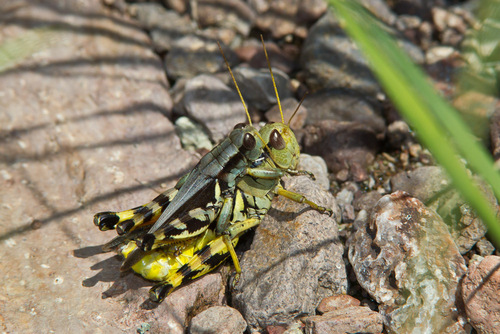
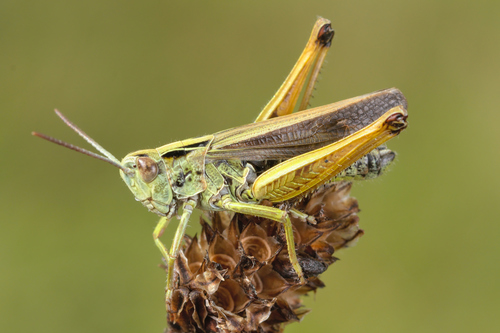
Morphology Omocestus viridulus individuals are usually entirely green, though some may have brown coloration on their sides. In Scandinavia, they are most commonly green or light brown. Males of this species have no red coloring on the abdomen, and the species possesses a noticeably long ovipositor; these two characteristics help distinguish it from the similar species O. rufipes and O. haemorrhoidalis. The eyes of Omocestus viridulus may be brown or yellow. The typical body length of this species is 17–20 millimetres (0.67–0.79 in). They have a strongly darkened region on the hind wing.
Distribution and habitat Omocestus viridulus typically lives in moderately wet regions across most of Europe, excluding areas north of the Arctic Circle, and is widely distributed throughout Britain. Its range extends eastward as far as Siberia and Mongolia. Its preferred habitat is areas with longer grass.
Diet and life cycle This species prefers to feed on more common, abundant grass species, and this feeding may promote greater vegetation diversity. O. viridulus feeds on grasses from the genera Dactylis, Agrostis, Anthoxanthum, Lolium and Holcus. The life cycle begins when females lay their egg clutches in the top layer of soil, or near the roots of grass stalks. The young, called nymphs, emerge the following April. These nymphs resemble miniature versions of adults, but with immature wings. After around a month of moulting their exoskeleton several times, they mature into fully developed adults with functional wings. There is one generation of O. viridulus per year, and adults are usually seen between April and October.
Reproduction Compared to other grasshopper species, the reproductive fitness of O. viridulus tends to be less affected by temperature changes. Studies have found that for female O. viridulus, the number of eggs per pod and the mass of the eggs are not adversely affected by temperature. In the wild, males find females quickly to mate, and females do not sing until after they have laid at least one cluster of eggs. If a male fails to mate with a female, he will sing before attempting to mate again.