About Olyra latifolia L.
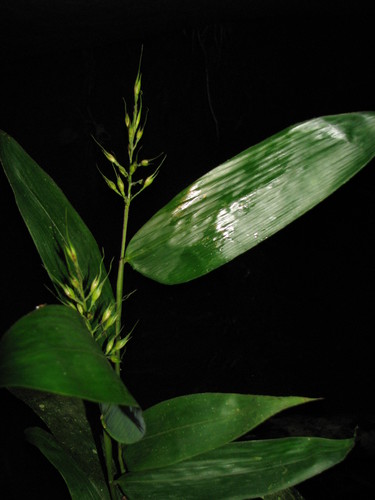
Olyra latifolia L. is a sturdy bamboo that reaches up to 5 m (16 ft) in height. Its stems can be erect or arching, and sometimes grow climbing, leaning on other vegetation, or lying flat against the ground. Its leaves range in shape from ovate to oblong, growing up to 20 cm (8 in) long and 7 cm (3 in) wide. The leaf base narrows into a hairy "pseudo-petiole", and the leaf apex ends in a long point. Its inflorescence is a branched terminal panicle reaching up to 18 cm (7 in) long; its branches are either stiffly ascending or spreading. The tip of each branch is swollen and holds one large pistillate floret, while several smaller, slender-stemmed staminate florets grow further down the branch. In this species, the inferior glumes are half the length of the superior glumes. This bamboo occurs naturally in both the New World and Old World. In the Americas, its range covers the West Indies, Mexico, and Central and South America, extending south to Paraguay, Bolivia, and northern Argentina. In Africa, it is found in sub-Saharan Africa, extending south to Angola, Zambia, Zimbabwe, and Mozambique, as well as on Madagascar and the Comoro Islands; it has also become naturalised in South Africa. It is a common, somewhat weedy rainforest species that grows in primary forests, secondary forests, and gallery forests, mostly near tree edges, and generally occurs at altitudes below 1,000 m (3,300 ft). This bamboo can be propagated from culms (stems) growing up from the rhizome, or from seed. The stems of Olyra latifolia have been used for drinking straws and to make spinning bobbins.