About Olsynium douglasii (A.Dietr.) E.P.Bicknell
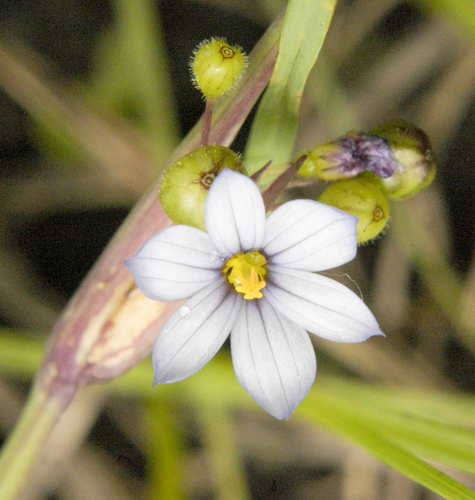
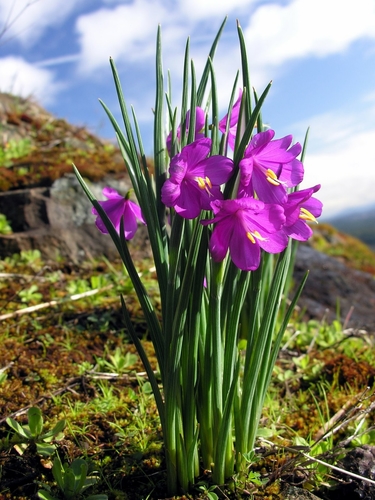
Olsynium douglasii (A.Dietr.) E.P.Bicknell is a species of flowering plant in the iris family Iridaceae. Its common names include Douglas' olsynium, Douglas' grasswidow, grass-widow, blue-eyed grass, purple-eyed-grass, and satin flower. It is the only member of the genus Olsynium found in North America; the remaining 11 species of the genus are native to South America. This species was formerly classified within the related genus Sisyrinchium. Despite common names that reference grass, it is not a true grass from the family Poaceae. Olsynium douglasii is a bulb-forming herbaceous perennial, that grows between 10 to 40 cm (3.9 to 15.7 in) tall. Its leaves are slender and linear, measuring 10 to 30 cm (3 7/8 to 11 3/4 in) long and 1.5 to 3 mm broad, and typically have pale longitudinal stripes. Its showy flowers bloom in early spring, ranging from bell-shaped to star-shaped, and are 15 to 25 mm long. Each flower has six purple tepals, which may sometimes be pale or white. The anthers are dark yellow to orange, and the filaments that hold the anthers are fused only along their lower portion. This plant is native to western North America, ranging from southern British Columbia south to northern California, and east to northwest Utah. It grows in open areas, usually in full sun. There are two recognized varieties of this species. Olsynium douglasii var. douglasii is found in coastal western North America, and has flower filaments with a narrow base. Olsynium douglasii var. inflatum occurs in interior western North America, and has flower filaments with an inflated base. This species has been awarded the Royal Horticultural Society's Award of Garden Merit.