About Olla v-nigrum (Mulsant, 1866)
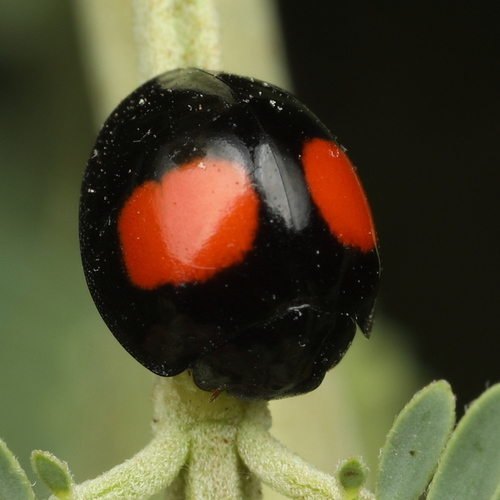
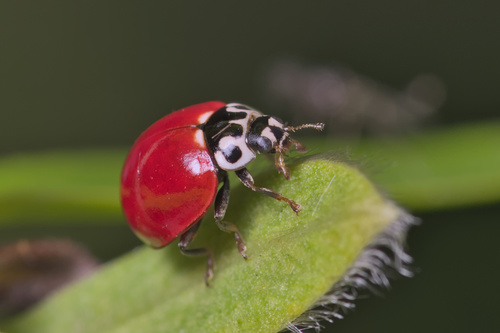
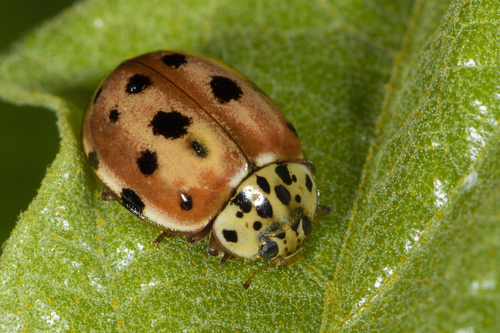
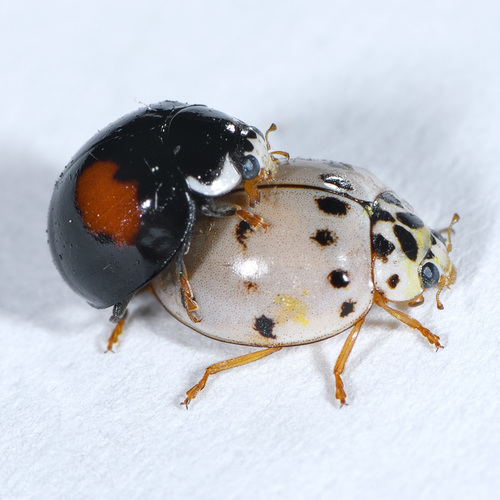
Olla v-nigrum (Mulsant, 1866) is a species of lady beetle in the family Coccinellidae, suborder Polyphaga, commonly known as the ashy gray lady beetle. Its distribution includes Central America, North America, and Oceania. It is typically gray or pale tan with small black spots on its elytra and thorax, but there is a common color variant that resembles the lady beetle Chilocorus orbus: this variant is black with two red spots on the wing covers, and white along the edge of the prothorax. The specific epithet "v-nigrum" comes from Mulsant's original description, which noted the pronotum (prothorax) was "adorned with a V and four black dots".
This species is indigenous to Florida, but can be found across the continental United States, and ranges as far south as Argentina. It was introduced to Hawaii and Guam for biological control purposes, and other introduction efforts established populations in New Caledonia and Reunion Island in Asia. It has also been released in southeastern France, Israel, and Czechoslovakia, though its current population status in these areas is unknown as no surveys have been conducted after the initial release. Olla v-nigrum has become less common across North America due to competition with the invasive exotic Asian lady beetle (Harmonia axyridis). Both species occupy the same prey niche, but Asian lady beetles are less susceptible to parasites. As Asian lady beetles have spread to South American countries including Argentina and Brazil, Olla v-nigrum populations there are expected to decline. In recent years, Olla v-nigrum has also become established on the Canary Islands: it was first recorded in 2014 on Tenerife and La Palma, then later on Lanzarote and Gran Canaria, and was recorded in Madeira in 2020.
Olla v-nigrum has a quick life cycle. Its egg stage lasts an average of one to two days, followed by a short larval stage of around seven days, a pupal phase of four to five days, and an egg-to-adult development period of around 16 days. The total life cycle from larva to adult lasts approximately 25 days. Over 80% of eggs usually produce individuals that survive past the larval stage. Adult Olla v-nigrum typically live around 60 days, and the average interval between generations is approximately 52 days. O. v-nigrum larvae have elongated, segmented abdomens. After hatching, larvae do not move far, remaining near their egg clutch and even consuming any infertile eggs produced in the clutch.
Olla v-nigrum most commonly preys on psyllids, a group of plant-feeding insects; local populations of the beetle often grow in response to increases in psyllid numbers. It prefers to feed on immature psyllids such as psyllid larvae, and has specifically been recorded preying on the Asian citrus psyllid (Diaphorina citri). It also feeds on a wide range of aphid species including Schizaphis graminum, Hyadaphis sp., Metopolophium dirhodum, Uroleucon sp., Breviocryne brassicaee L. and Myzus sp.
Testing of interactions with Southern green stink bug (Nezara viridula) found that Olla v-nigrum rarely preys on living Southern green stink bugs, but will more readily feed on dead stink bug nymphs. This is hypothesized to be because living Southern green stink bugs produce a defensive secretion that deters predation. Only 4th instar Olla v-nigrum attack Southern green stink bugs at a high rate; adults do not attack them at all. This beetle species also feeds on eggs and larvae of beetles (Coleoptera) and moths/butterflies (Lepidoptera), and feeds on aphids directly from host plants.
Laboratory rearing research has tested the effects of feeding adult Olla v-nigrum a combination of the flour moth Anagasta kuehniella alongside an artificial diet composed of yeast, honey, ascorbic acid, and water. This diet produced an average of 11.7 eggs per egg mass, with an average egg viability of 54.8%. The length of larval instars did not differ from other diets, but further research is needed to adjust this diet to improve Olla v-nigrum rearing outcomes.
Olla v-nigrum is used alongside pesticides for integrated pest control of pecan aphids on cultivated pecan trees (Carya illinoensis), targeting the black pecan aphid (Melanocallis caryaefoliae), yellow pecan aphid (Monelliopsis pecanis), and blackmargined aphid (Monellia caryella). It is a useful component of integrated control because it experiences lower mortality from many common pesticides than other predatory beetles used for this purpose. However, Olla v-nigrum has very high mortality when exposed to carbaryl, a common late-season pesticide for pecan pest control, which can limit its usefulness for integrated pecan aphid management.