About Oligodon cinereus (Günther, 1864)
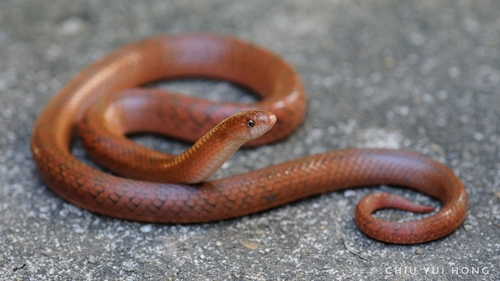
This species, Oligodon cinereus (Günther, 1864), has the following morphological description. For terminology, refer to snake scales. The nasal scale is divided; the portion of the rostral scale visible from above is as long as its distance from the frontal scale, or a little shorter. The suture between the internasal scales is usually shorter than the suture between the prefrontal scales. The frontal scale is as long as its distance from the end of the snout, and matches the length of the parietal scales. The loreal scale is usually longer than it is deep. There is a single preocular scale, usually with a small subocular scale below it, positioned between the third and fourth labial scales. There are either one or two postocular scales. Temporal scales follow a 1+2 arrangement. There are 8 upper labial scales, with the fourth and fifth entering the eye orbit; 3 or 4 lower labial scales are in contact with the anterior chin shields. Posterior chin shields are half the size of the anterior chin shields, or smaller than half the size of the anterior chin shields. Dorsal scales are arranged in 17 rows. Ventral scales number 160–180, with a recorded maximum of 196. The anal scale is undivided; subcaudal scales number 34–39. The dorsal body color is pale brown, purplish, or reddish. Head markings are very indistinct, and the body is uniformly colored both above and below. The maximum recorded total body length is 30 inches, with a tail length of 3 inches. Oligodon cinereus occurs in northeast India (Assam and Arunachal Pradesh), Bangladesh, Myanmar, Thailand, Cambodia, Laos, Vietnam, Peninsular Malaysia, and southern China (including Hong Kong and Hainan).