About Olearia rugosa (Archer) Hutch.
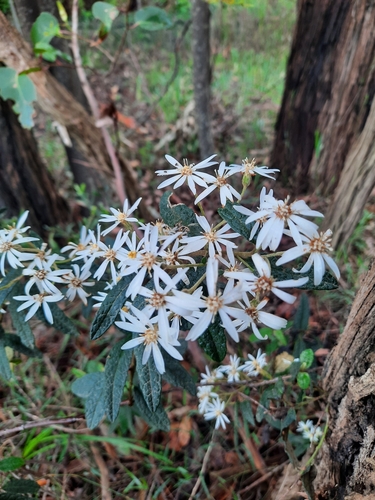
Olearia rugosa (Archer) Hutch. is a shrub that sometimes grows with a spindly habit, reaching up to 2.5 m (8 ft 2 in) in height. Its branchlets are densely covered in short, matted, star-shaped hairs. Its leaves are arranged alternately, and may be almost sessile or borne on a petiole. Leaves are broadly elliptic, oblong, or egg-shaped, measuring 7–80 mm (0.28–3.15 in) long and usually 7–25 mm (0.28–0.98 in) wide. The upper leaf surface is green, veined, wrinkled, and warty, with occasional fine star-shaped hairs on some leaves. The lower leaf surface is densely covered in soft grey-brown hairs. Leaf margins range from broadly toothed to scalloped, are flat or curved downward, and are only rarely smooth. Flower heads are 20–25 mm (0.79–0.98 in) in diameter, borne in upper leaf axils or at the ends of branches, either singly or in corymbs, on a peduncle 0.5–5 cm (0.20–1.97 in) long. White ray florets occur in groups of 8 to 13, with ligules 7–10 mm (0.28–0.39 in) long, and the central disc florets are yellow or purplish. The involucral bracts are toothed, sometimes have purple-tinged margins, and are densely covered in short, matted, star-shaped hairs, or only have this hair covering near the bract apex. The dry, one-seeded fruit is cylindrical and ribbed, measuring 2–2.5 mm (0.079–0.098 in) long, and is either smooth or has a moderate covering of silky hairs. There are five accepted subspecies, each with distinct distributions and habitats. Subspecies allenderae grows in swampy areas or on gully slopes in forest, and is restricted to Wilsons Promontory National Park. Subspecies angustifolia usually grows along streams or in swamps in near-coastal areas of East Gippsland, Victoria. Subspecies distaliloba grows in mountain forest, often in gullies and depressions, and occurs in far south-eastern New South Wales and east of the Snowy River in Victoria. Subspecies intermedia is restricted to some Bass Strait Islands and north-eastern Tasmania. Subspecies rugosa grows in moist forests, mostly on the Great Dividing Range between Mount Macedon and Drouin in central southern Victoria.