About Olearia pinifolia (Hook.fil.) Benth.
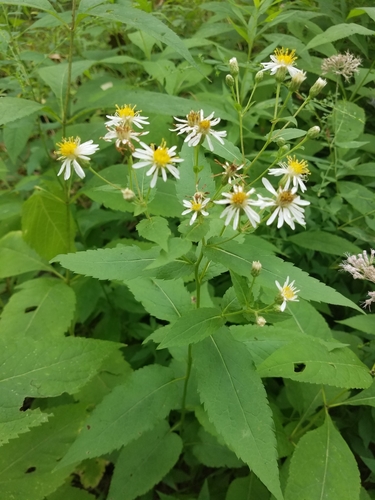
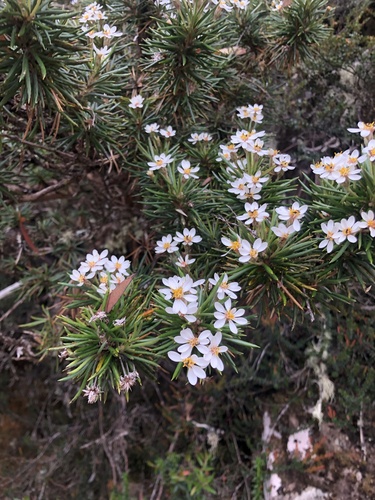
Olearia pinifolia (Hook.fil.) Benth. is a rigid, bushy shrub that typically grows to 1.5 metres (4 feet 11 inches) in height, and has stout, woolly-hairy branches. Its leaves are arranged alternately along the branches, are crowded and narrowly linear, and measure 25–38 mm (0.98–1.50 in) long. The leaves are rigid and sharply pointed, with edges rolled under, which gives the plant a pine-like appearance. The upper leaf surface is glabrous, while the lower leaf surface is silky-hairy and obscured. The daisy-like flower heads are mostly arranged singly at the end of a long peduncle, and have a top-shaped involucre. Each flower head holds 8 to 10 white ray florets surrounding a larger number of yellow disc florets. The achenes are long, narrow and smooth, and the pappus has bristles arranged in several rows. This species is common in the alpine or subalpine regions of Tasmania, including on Mount Wellington, Mount Dundas, Mount Sorell and Mount Field. Olearia pinifolia is resistant to Phytophthora cinnamomi, the pathogen that causes root rot. It may be susceptible to mealybug, which feed on the plant's juices and may carry other diseases. For horticultural use, seeds can be collected from seeding Olearia pinifolia in late summer to early autumn, between January and March, when the plant releases its fluffy white achenes. Collected achenes can be dried, and sown within a short time in a surface layer of loamy, low-phosphorus soil to produce young O. pinifolia seedlings. The best sowing months for this species in Tasmania are March-April and October-November, when conditions are mild and frosts are rare. Germination occurs two to five weeks after sowing. Plants can also be propagated from cuttings taken from healthy, young specimens.