About Olearia pimeleoides (DC.) Benth.
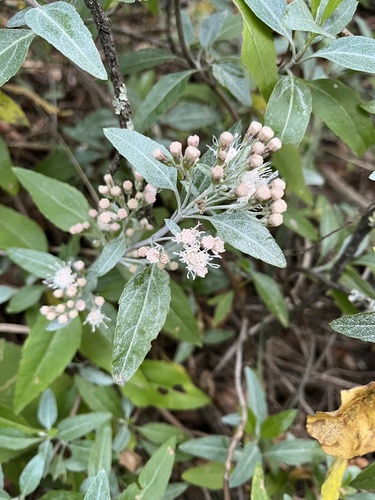
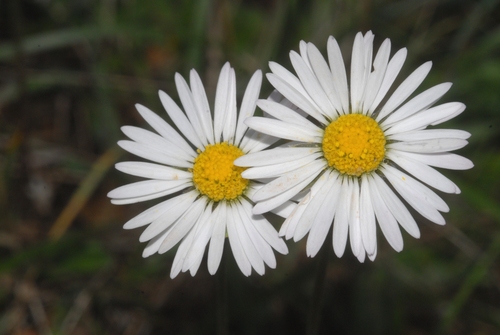
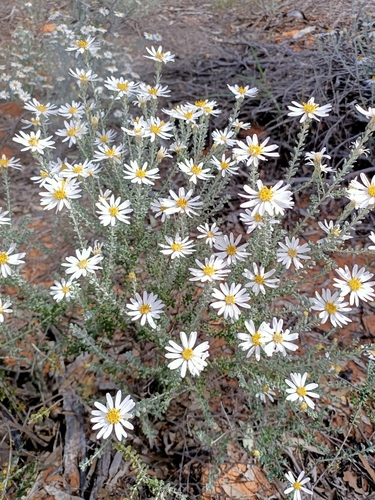
Olearia pimeleoides, commonly known as pimelea daisy-bush, is a shrub that usually reaches a maximum height of around 1 meter (3 feet 3 inches). Its branchlets are covered in dense, white woolly hairs. Leaves are arranged alternately along the branches, and are shaped elliptic, linear, or lance-shaped with the narrower end at the base. They measure 3 to 15 millimeters (0.12 to 0.59 inches) long and 1 to 6 millimeters (0.039 to 0.236 inches) wide, and are more or less sessile. The lower surface of the leaves is densely covered in white, woolly hairs. The daisy-like flower heads are typically arranged singly at the ends of branches, are sessile, and measure 15 to 35 millimeters (0.59 to 1.38 inches) in diameter, with a conical to hemispherical involucre at their base. Each flower head holds 8 to 25 white ray florets, with ligules 8 to 20 millimeters (0.31 to 0.79 inches) long, surrounding 14 to 15 pale yellow disc florets. Flowering takes place from August to October. The fruit is an achene 1.5 to 3.0 millimeters (0.059 to 0.118 inches) long, with a pappus 7 to 9 millimeters (0.28 to 0.35 inches) long. This species is widespread and common across southern Australia, where it grows in mallee woodlands, mallee shrublands, and forest. It occurs widely in south-west Western Australia, south-east South Australia, north-western Victoria, and the western plains of New South Wales.