About Olearia phlogopappa (Labill.) DC.
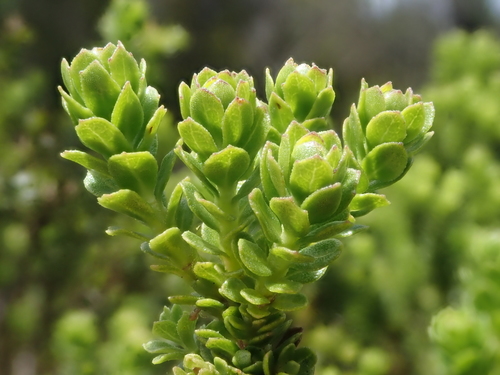
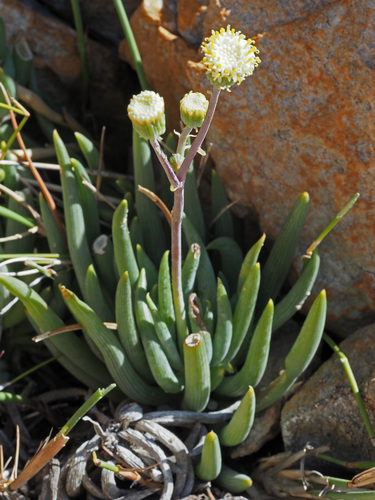
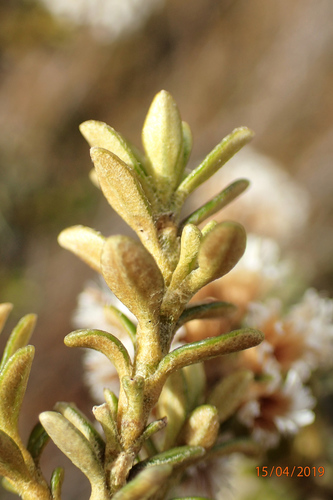
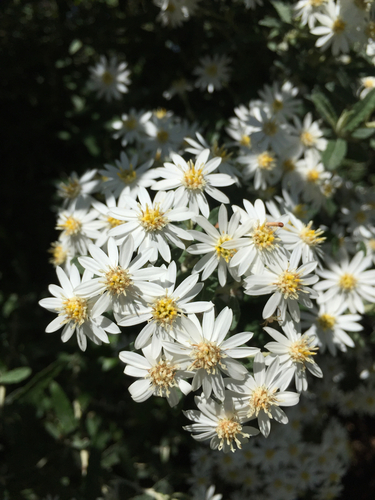
Olearia phlogopappa (Labill.) DC., commonly called the dusty daisy-bush, is a small, erect shrub that reaches 0.3–3 m (0.98–9.8 ft) in height and has greyish foliage. Its leaves are arranged alternately, and vary in shape from narrow egg-shaped to narrow obovate. They measure 8–114 mm (0.31–4.5 in) long and 3–23 mm (0.12–0.91 in) wide, and grow on a short stalk. The upper leaf surface is dull grey-green, and is either smooth or covered in fine, minute star-shaped hairs; the underside appears whitish or yellowish. Leaf margins also vary, and may be slightly scalloped, toothed, or bear evenly spaced slanting serrations. Flower heads of the dusty daisy-bush vary in colour, with white being the most common, but may also be blue or pink. The flowers are borne in terminal clusters from side branches, and each flower head is around 15–25 mm (0.59–0.98 in) in diameter. The 4 to 5 bracts are bell-shaped to hemispherical, arranged in rows, covered with short soft hairs, and are occasionally glandular. Individual daisy-like flower heads usually have 10 to 14 ray florets, and blooming occurs in spring and early summer. The fruit is an achene (a single-seeded dry fruit) that is 2–3 mm (0.079–0.12 in) long and has 5 ribs. Olearia phlogopappa is widespread and common from coast to mountain elevations, growing in both dry and wet sclerophyll forests. It is found in eastern New South Wales, Victoria, and Tasmania. The broader genus Olearia, which is native to Australia, New Zealand and New Guinea, contains around 130 species native to Australia. Subspecies continentalis grows in scattered locations in New South Wales, is common in Victoria, and occurs in moist to wet forest. Subspecies flavescens is found in New South Wales, is widespread in Victorian alpine and subalpine locations, and grows in heath, scrubland and rocky areas. Subspecies insularis grows in Victoria and Tasmania, and is usually found in coastal heath, deep sand or on sand dunes. Subspecies phlogopappa grows in Victoria in moist to wet situations with good drainage. Subspecies salina has a restricted distribution in Victoria and Tasmania, and grows mostly from wet forests to dry woodland. Subspecies serrata has a restricted distribution in Victoria and New South Wales, and grows on slopes and near headwaters in open heath close to eucalypt woodlands. In cultivation, this species withstands moderate frost and drought, but prefers moist conditions and well-drained soil in a sunny position; flowering is reduced when grown in partially shaded positions. Pruning is required to prevent plants from growing spindly, and the species can be propagated from seed or tip cuttings.