About Olearia paniculata (J.R.Forst. & G.Forst.) Druce
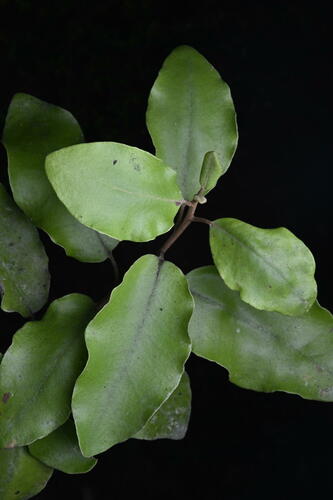
Olearia paniculata (J.R.Forst. & G.Forst.) Druce, also referred to as Shawia paniculata and commonly called akiraho, is a small evergreen tree endemic to New Zealand. It is indigenous and commonly found across both the North and South Islands of New Zealand, from East Cape to south Canterbury; it is not native to Taranaki, but grows rapidly there as a cultivated hedge plant. This species can reach a maximum height of around 6 meters. Its twigs are reddish, grooved along the top surface, angular in cross-section, and its branchlets are grooved, sharp-cornered, very short, reaching lengths of 2 to 4 centimeters. Leaves are oval, green, very smooth with wavy edges that may be flat or strongly wavy, and are white underneath. The leaf petiole, the stalk that connects the leaf blade to the stem, grows up to 5 millimeters long, and the underside of the leaves bears a thin, appressed tomentum that ranges from white to buff. This plant has a sweet scent. Its flowers are small, white, borne in dense panicles; the specific epithet paniculata means 'tufted', referring to this panicle arrangement. The former genus Shawia is named after Thomas Shaw, an English scholar and traveller. This species does not occur in naturally regenerating mature forest. Its typical wild habitat is associated with non-local seed sources, in areas with roughly 50% grass cover, around clumps of 3-meter-tall plantings up to 5 square meters in area, alongside other common forest floor shrubs, herbs, and ferns. It is adapted to dry soils and windy conditions, making it common in coastal areas. It prefers full sun to partial shade and well-draining soil; it cannot tolerate saturated soils, which can kill the plant, but it tolerates moderate frosts. It produces daisy-like flower clusters in late autumn; its flowering period falls between March and May, and its fruiting period between April and July. It establishes well after autumn rains, when the soil is soft, moist and warm, allowing it to become well established before winter. This species is widely cultivated and commonly used to create hedges. In cultivation, it needs water to grow, but not excessive water. To plant akiraho, prepare slightly raised beds of well-cultivated soil, amended with coarse sand, compost, or organic material to improve soil health and moisture structure; this creates good drainage and provides aerated soil for near-surface root growth. When planting, dig a hole twice the diameter of the plant's root ball, ensure the root ball is saturated before planting, and water the plant after planting. Young plants need thorough watering during dry periods over their first two to four years, and mulching to conserve moisture and suppress weeds. Its dense evergreen foliage can support durability, water conservation, and protection from predators.