About Olearia frostii (F.Muell.) J.H.Willis
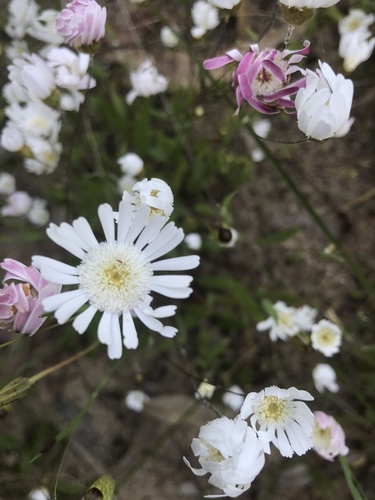
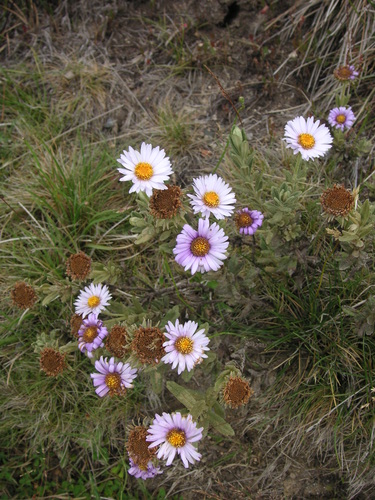
Olearia frostii is a greyish, often straggling shrub that usually reaches a maximum height of 40 cm (16 in). Its branchlets are densely covered in star-shaped hairs. The leaves of this shrub are arranged alternately along the branchlets, are more or less sessile, and are narrowly egg-shaped with the narrower end oriented toward the base. Each leaf measures 8–30 mm (0.31–1.18 in) long and 5–13 mm (0.20–0.51 in) wide. The upper leaf surface is covered with greyish, star-shaped hairs, while the lower leaf surface is densely covered in woolly, star-shaped hairs. The daisy-like flower heads are arranged singly on the ends of a small number of branches. Each head is 25–50 mm (0.98–1.97 in) in diameter, borne on a peduncle that is mostly 30–100 mm (1.2–3.9 in) long, with three to five rows of bracts at its base. Every flower head holds 30 to 80 mauve to pink ray florets, with ligules 8–15 mm (0.31–0.59 in) long, that surround 40 to 100 yellow disc florets. Flowering takes place from January to March, and the fruit that forms after flowering is a hairless achene, with a pappus 5–7 mm (0.20–0.28 in) long. Olearia frostii grows in heath, grassland, and woodland on the Bogong High Plains and nearby peaks in north-eastern Victoria.