About Olearia erubescens (Spreng.) Dippel
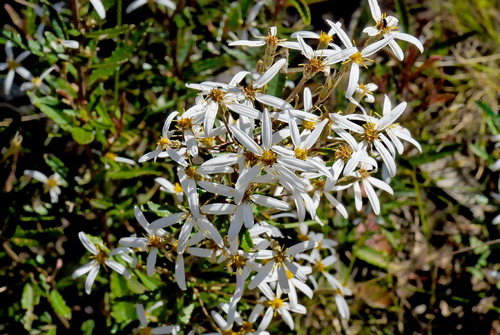
Olearia erubescens, commonly known as moth daisy bush, is a spreading woody shrub. At lower altitudes, where it grows in grassland and wooded gullies, it reaches 0.5–2 m (1.6–6.6 ft) high and 0.5–1 m (1.6–3.3 ft) wide. At higher altitudes, it develops a gnarled, smaller growth habit, reaching only 40 cm (16 in) high. Its branchlets are densely matted with soft, whitish T-shaped hairs. Leaves are alternately arranged on a short 11 mm (0.43 in) long stalk, and may be either sparse or crowded, ending in a sharp point. The leaves are narrowly oval to oblong, measuring roughly 15–125 mm (0.59–4.9 in) long and 3–20 mm (0.12–0.79 in) wide, with small, coarse, irregular teeth or slightly lobed serrations along the margins. The upper leaf surface is smooth, dark green, flat, and stiff, with a distinctive pale network of veins. The underside of the leaf is thickly covered in white hairs, and is occasionally reddish when young. Inflorescences hold 4 to 8 flowers, which are most often white, occasionally pinkish mauve. Flowers are about 15–31 mm (0.59–1.2 in) in diameter, and bloom at the end of branches on a 1–4 cm (0.39–1.6 in) long peduncle. Flower clusters are borne in leaf axils on shoots from the previous growing season. The centre of the floret is yellow. Cone-shaped bracts are arranged in 3 to 5 rows, measure 4.5–7 mm (0.18–0.28 in) long, and are covered in dense, silky, flat hairs. The dry fruit is single-seeded, narrowly cylindrical, 3–4 mm (0.12–0.16 in) long, and ribbed. Flowering occurs from September to January. This species is widespread across coastal and mountainous areas of south-eastern Australia. In New South Wales, it occurs from the Blue Mountains, west to Orange and Drake in the Northern Tablelands. It is also found in South Australia, Victoria and Tasmania. It grows in rocky locations, sclerophyll forests, woodland and montane forests.