About Olearia ciliata F.Muell., 1865
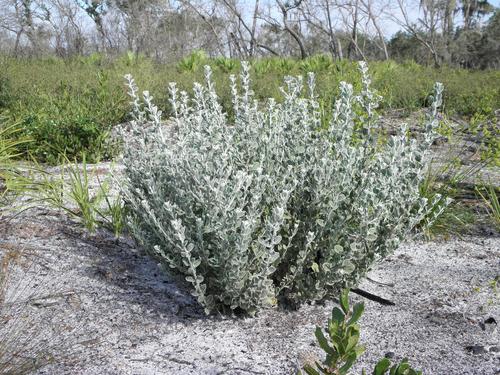
Olearia ciliata, commonly known as the fringed daisy-bush, is a small, upright, spreading shrub that grows 15–30 cm (5.9–11.8 in) tall. It has more or less woody, wiry, reddish stems that are 2–15 cm (0.79–5.91 in) long; the stems are rough with short hairs, finely ribbed, and usually branch from the plant's base.
The upper surface of the leaves is bright green, rough or slightly smooth, while the leaf underside is paler and covered in hairs. Leaves are sessile, linear to narrow in shape, and taper gradually to a fine point, though they occasionally have a lobed apex. They measure 0.5–2 cm (0.20–0.79 in) long and 1–2 mm (0.039–0.079 in) wide. Leaf margins are entire, rolled under, fringed, and rough with short white hairs.
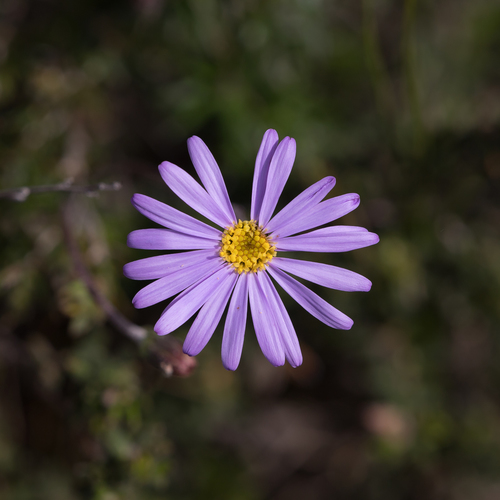
Single flower heads are borne at the end of an unbranched peduncle 2–25 cm (0.79–9.84 in) long. There are 3 overlapping green bracts, which are woolly, narrow lance-shaped, and fringed. The flower heads are 2–3 cm (0.79–1.18 in) across; the mauve to purple ligules (ray florets, commonly called petals) are 12–15 mm (0.47–0.59 in) long, and the yellow flower centre is made up of 40 to 75 disk florets.
The fruit is a dry, one-seeded achene (capsule) about 2 mm (0.079 in) long, which may be smooth or covered in fine soft hairs, and has faint longitudinal lines. Olearia ciliata flowers from late winter to spring, and occasionally flowers in autumn.
This widespread species is found in several southern Australian states, growing predominantly on well-drained sandy soils. In Victoria, it grows in sandy and mallee heath in north-west Victoria, and in scattered locations in woodlands of the Grampians, Brisbane Ranges and Wilsons Promontory. In Western Australia, it grows on rocky lateritic or sandy soils on coastal dunes and sand plains, mainly near Esperance and Albany. In South Australia, it occurs mostly on coastal fringes, and in Tasmania it is found along the east and south-east coast.