About Olearia asterotricha (F.Muell.) F.Muell.
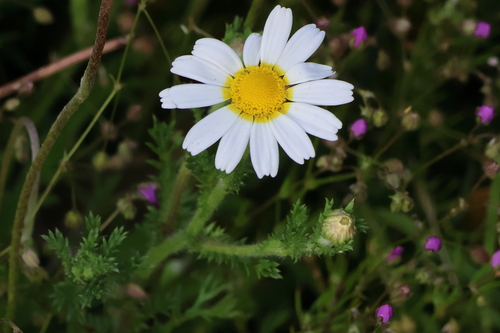
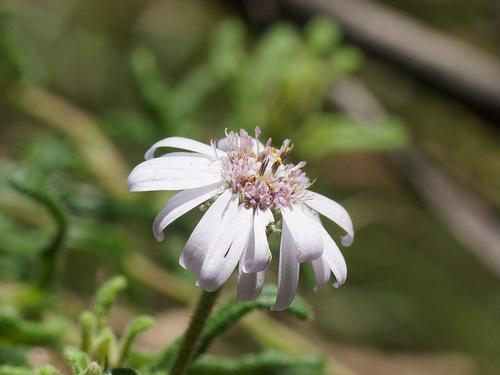
Olearia asterotricha, commonly known as the rough daisy bush, is a small, sprawling shrub with an open growth habit. It typically reaches 1 to 2 metres (3.3 to 6.6 ft) in height and spreads 1.5 to 2 metres (4.9 to 6.6 ft) wide. Its branchlets are covered in either densely matted woolly hairs, star-shaped hairs, or a mix of both. The species produces daisy-like flowers that may be white, pale mauve, or blue, with a yellow or purplish centre. Each flower is 2 to 4 cm (0.79 to 1.6 in) in diameter, and grows either singly or in clusters of 25 to 40 at the end of stems. Every inflorescence sits on a peduncle roughly 50 mm (2.0 in) long. The inflorescence bracts bear fine, short matted hairs, and are arranged in 1 to 3 rows. Its dark green leaves are arranged alternately along stems, and may have a very short stalk or no stalk at all. Leaves are broadly linear or oblong in shape, measuring 0.6–2.5 cm (0.24–0.98 in) long and 0.2–0.8 cm (0.079–0.31 in) wide. Both the upper leaf surface and stems are covered in rough star-shaped hairs, while the underside of leaves is densely woolly. Leaf margins are either entire or toothed, and are rolled under. The fruit is cylindrical, about 3 mm (0.12 in) long, with 6 to 8 ribs that are also around 3 mm (0.12 in) long. Fruit surfaces range from smooth to sparsely covered in matted hairs, and contain a single dry seed that does not open when mature. The rough daisy bush grows naturally from the Blue Mountains in New South Wales to western Victoria, Australia, where it mostly occurs in cool, damp, acidic soils, in heath or dry sclerophyll forest. The species varies in form depending on its geographic region: plants from the Sydney region are compact shrubs with white flowers and grey-green foliage, while Victorian plants have mauve-blue flowers, green leaves, and a more open growth habit. The species is considered rare in Victoria. Four subspecies are recognised with distinct distributions: Olearia asterotricha subsp. asterotricha is only found at elevated sites in Grampians National Park, growing in sandy soils in heath woodland; Olearia asterotricha subsp. glaucophylla grows north of Mittagong in New South Wales; Olearia asterotricha subsp. lobata grows in wet heathland or moist forest, usually at lower altitudes, and also occurs in a small number of disjunct areas in southern Victoria, where it is generally uncommon; Olearia asterotricha subsp. rotundifolia is thought to be restricted to a single population located directly below the summit of Mt Langi Ghiran, Victoria, where it grows in damp situations on southern slopes around granite boulders.