About Olearia argophylla (Labill.) F.Muell.
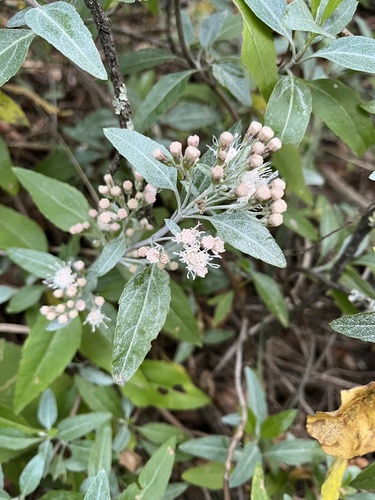
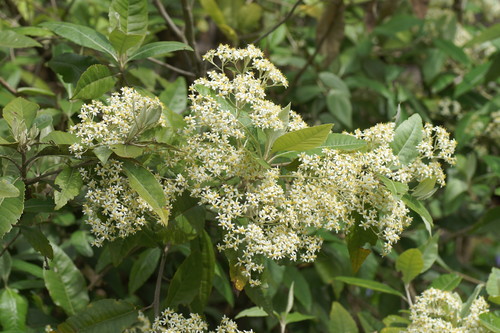
Olearia argophylla (Labill.) F.Muell. is a shrub or tree that usually grows to a maximum height of around 10 meters (33 feet), with bark that ranges from fissured to slightly stringy or flaky. Its branchlets are densely covered with fine, silvery or pale brown hairs that lie pressed against the branchlet surface. Leaves are arranged alternately, with shapes ranging from egg-shaped to broadly elliptic. Most leaves are 30–120 mm (1.2–4.7 in) long and 20–70 mm (0.79–2.76 in) wide, attached by a petiole up to 25 mm (0.98 in) long, and have toothed margins. The upper leaf surface is glabrous, while the lower leaf surface is covered in minute, woolly, white or silvery hairs. Flower heads are 13–27 mm (0.51–1.06 in) wide and arranged in corymbs at the ends of branchlets, with each corymb borne on a peduncle up to 20 mm (0.79 in) long. Each daisy-like flower head has three to eight white ray florets, with petal-like ligules measuring 4–10 mm (0.16–0.39 in) long, surrounding three to eight yellow disc florets. Flowering occurs mainly from September to February. The fruit is a straw-coloured or pinkish achene 2.5–4.0 mm (0.098–0.157 in) long, with a pappus made of 26–43 bristles approximately 5 mm (0.20 in) long. This species commonly grows on cool, moist, sheltered slopes and in fern gullies within taller eucalypt forests. Its range extends south from the Whian Whian State Conservation Area in eastern New South Wales, through the Australian Capital Territory, across most of eastern Victoria excluding the Grampians, to Tasmania where it is common and widespread. Olearia argophylla can be propagated from either seed or cuttings for horticultural use. It grows best in partial to full shade, in neutral or slightly acidic soils, and is tolerant of frost.