About Olearia albida Hook.fil.
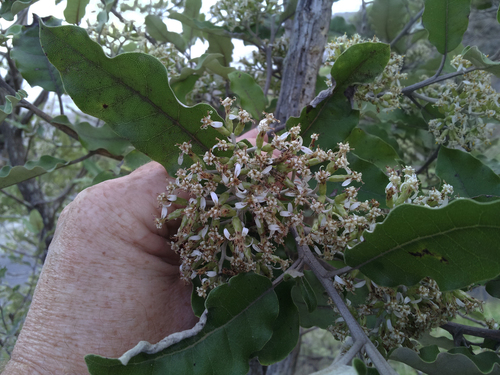
Hooker's original type description of Olearia albida Hook.fil. reads: it is a small tree, very similar to Olearia Forsteri in growth habit and foliage. However, its leaves do not show obvious reticulate venation on either surface; the leaf underside is softer and very white, and its panicles are larger and more spread out. The flower heads are quite different from those of O. Forsteri, they are borne on pedicels, 5.1 mm (0.2 in) long, and subcylindric. The involucral scales are overlapping, short, obtuse, and covered in fine hairs; there are 2 or 3 florets per head, one of which is often ligulate; the pappus is white and uneven in length. The achene is covered in fine hairs. This species has grooved, flaky bark and light green leaves with a white underside, and the leaves are typically wavy. It produces white flowers that usually grow in clusters, and can reach a maximum height of 5 m (16 ft). Olearia albida is endemic to New Zealand. It occurs on the North Island as far south as northern Taranaki, and also grows on the offshore islands of the Hauraki Gulf. Notable locations where the species is found include Tāpapakanga Regional Park and the northern shores of the Matakana River mouth. It grows in coastal areas, most commonly on headlands and in sites with loose soil, such as slip scars.