About Olea paniculata R.Br.
Growth Form
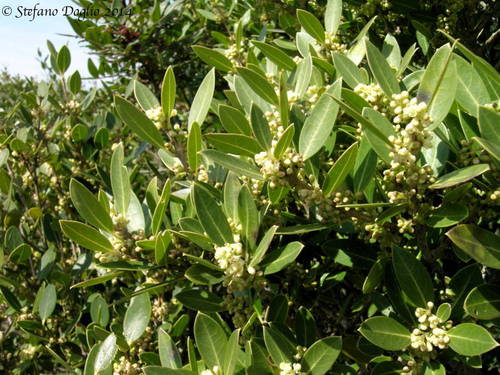
Olea paniculata R.Br. grows as a bushy tree reaching up to 30 m (98 ft) tall, and often has a sparse canopy.
Trunk Characteristics
Its trunk has smooth grey-brown bark, reaches a maximum diameter of 90 cm (35 in), and may have some buttressing.
Leaf Description
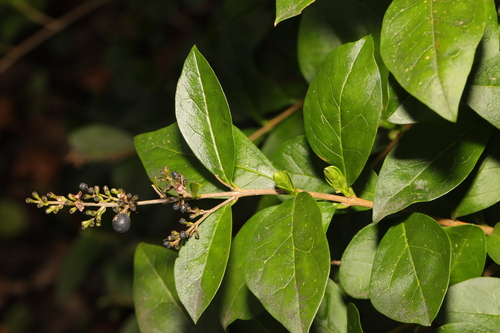
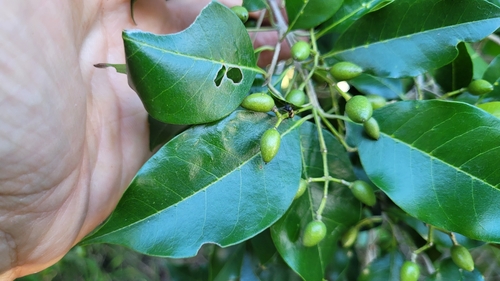
The shiny green leaves are ovate to elliptical in shape, measuring 5–10 cm (2.0–3.9 in) long and 1.5–6 cm (0.59–2.36 in) wide, with a pointed acuminate tip.
Fruit Description
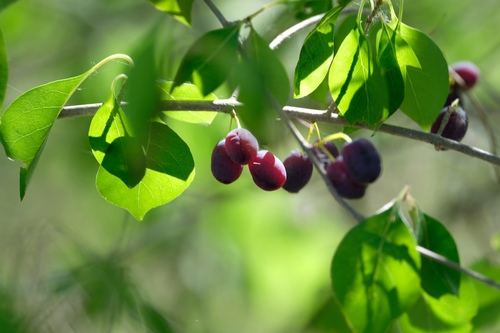
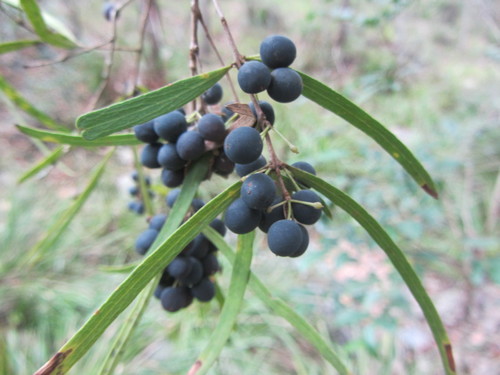
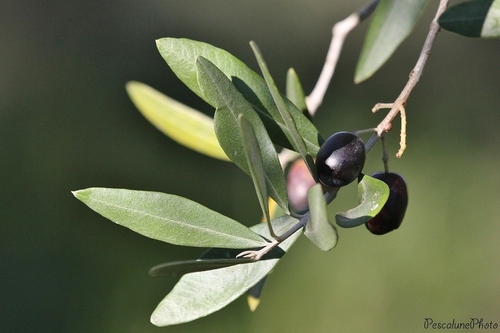
Its oval blue-black fruits are 0.8–1.2 cm (0.3–0.5 in) long, and ripen from May to September.
Similar Species
This species resembles the introduced weedy African olive, Olea europaea subsp. cuspidata. The introduced species differs by lacking the small depressions between the main and secondary leaf veins found on the underside of Olea paniculata leaves, and it grows in disturbed areas such as roadsides and waterways.
Australian Distribution
Olea paniculata ranges from northeastern Queensland to the area near the Hunter Region in New South Wales, Australia. Within Australia, it grows near watercourses in dry rainforests.
Yunnan Distribution
Outside Australia, it occurs in southwestern China’s Yunnan province, where it grows in sheltered wetter valleys at altitudes between 1,200–2,400 m (3,900–7,900 ft).
Broader Distribution
It is also found in India, Indonesia, Kashmir, Malaysia, Nepal, New Guinea, Pakistan, and Sri Lanka.
Island Distribution
On Lord Howe Island it is widespread below approximately 500 m (1,600 ft) elevation, and it also grows on New Caledonia and Vanuatu.
Fruit Consumers
In Australia, the fruit of Olea paniculata is eaten by the Australian king parrot, brown cuckoo-dove, topknot pigeon, rose-crowned fruit-dove, wompoo fruit-dove, white-headed pigeon, green catbird, and regent bowerbird.
Cultivation Requirements
It acts as a fast-growing pioneer species on sunny protected sites, and requires well drained soil for healthy growth.
Ecological Role
It is a butterfly host plant, and its black fruit attracts birds.
Traditional Use
Aboriginal Australians traditionally ate its fruit.