About Oldenburgia paradoxa Less.
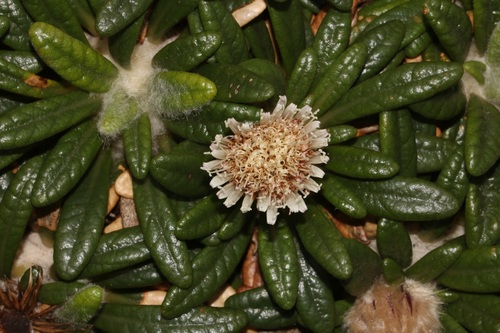
Oldenburgia paradoxa Less. is an unusually dense subshrub that generally grows as a hemispherical cushion. Though it may sometimes grow taller than one meter, it usually stays much shorter, commonly reaching about 30 cm in height. Its leaves are alternate, elliptical, and leathery, matching the typical appearance of the Oldenburgia genus. Mature leaves are deep green on the upper surface and white-felted on the lower surface, with slightly downward-rolled margins that give them a resemblance to loquat leaves. Young leaves are fully covered in bright white felt; as leaves mature, they lose the felt from their upper surface but keep it on their lower surface. Unlike leaves of other Oldenburgia species, the leaves of Oldenburgia paradoxa are densely and tightly packed at branch tips around the plant’s outer edge, and are much smaller, reaching around 10 cm in length. The plant’s branches have thick, corky bark that is usually not visible on undamaged plants. Its flower heads may grow on stalks or be nearly sessile. A distinguishing feature of this species among Oldenburgias is that its flower heads grow among the leaves right at the surface of the plant cushion, while other Oldenburgia species have tall stalks that hold flower heads well above the main plant. The flower heads are solitary, terminal, about 5 cm in diameter, and creamy in color, sometimes with a subtle pink or purple tint. This species is endemic to mountainous areas of the southern Western Cape Province in South Africa. Its conservation status is not clear; it has always been uncommon, and most remaining populations grow in mountain reserves. It grows on sandstone, on cliff faces, in rock crevices, and near mountain tops, where it experiences little competition from other plants.