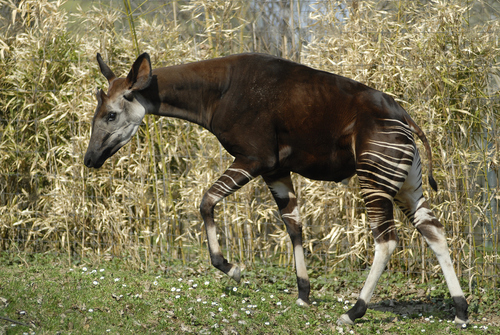
About Okapia johnstoni (P.L.Sclater, 1901)
Taxonomy and Classification
The okapi, scientifically named Okapia johnstoni (P.L.Sclater, 1901), is a medium-sized giraffid.
General Size Measurements
It reaches 1.5 m (4 ft 11 in) tall at the shoulder, has an average body length of about 2.5 m (8 ft 2 in), and weighs 200 to 350 kg (440 to 770 lb).
Basic Body Features
It has a long neck and large, flexible ears.
Coat Coloration and Pattern
Its coat ranges from chocolate to reddish brown, in sharp contrast to the white horizontal stripes on its legs and white ankles.
Striping Function
These distinctive zebra-like stripes work as effective camouflage in dense vegetation.
Facial and Upper Body Coloration
The okapi's face, throat, and chest are greyish white.
Foot Gland Features
Interdigital glands are present on all four feet, and are slightly larger on the front feet.
Male Ossicone Characteristics
Male okapis have short, hair-covered horn-like structures called ossicones, which are less than 15 cm (5.9 in) long and similar in form and function to giraffe ossicones.
Sexual Dimorphism
The okapi shows sexual dimorphism: females are an average of 4.2 cm (1.7 in) taller, slightly redder, and lack prominent ossicones, instead having hair whorls.
Habitat Adaptations Overview
The okapi has multiple adaptations for its tropical habitat.
Sensory Adaptations
A large number of rod cells in its retina support night vision, and it has an efficient olfactory system.
Auditory Adaptations
Its large auditory bullae on the temporal bone give it a strong sense of hearing.
Dental Formula
The okapi's dental formula is 0.0.3.3 / 3.1.3.3.
Tooth Structure and Function
Its teeth are low-crowned and finely cusped, and efficiently cut tender foliage.
Digestive System Features
A large cecum and colon aid microbial digestion, and a quick food passage rate means it digests less plant cell wall material than other ruminants.
Distinction from Giraffes Overview
The okapi can be easily told apart from its closest living relative, the giraffe.
Size Comparison to Giraffes
It is much smaller than the giraffe, and shares more external similarities with bovids and cervids.
Ossicone Differences from Giraffes
Only male okapis have ossicones, while both sexes of giraffes have this feature.
Unique Palatine Sinus Trait
The okapi has large palatine sinuses (hollow cavities in the palate), a trait unique among giraffids.
Shared Giraffid Morphological Features
Shared morphological features between okapis and giraffes include a similar pacing gait — both step simultaneously with the front and hind leg on the same side of the body, unlike other ungulates that move alternate legs on opposite sides when walking — and a long black tongue (longer in the okapi) that is used to pluck buds and leaves, as well as for grooming.
Endemic Range Overview
Okapis are endemic to the Democratic Republic of the Congo, where they live north and east of the Congo River.
Core Congolese Distribution
Their range extends north from Maiko National Park to the Ituri rainforest, then through the river basins of the Rubi, Lake Tele, and Ebola to the west, and continues to the Ubangi River further north.
Additional Congolese Populations
Smaller populations exist west and south of the Congo River, and the species is also common in the Wamba and Epulu areas.
Extirpation in Uganda
It is extinct in Uganda; there is evidence okapis were observed in Uganda's Semuliki Valley by Europeans before going extinct there in the late 1970s, and the Semuliki Valley has a similar habitat to the Congo Basin.
Habitat Elevation Range
Okapis inhabit canopy forests at elevations of 500–1,500 m (1,600–4,900 ft).
Habitat Use and Avoidance
They occasionally use seasonally inundated areas, but do not live in gallery forests, swamp forests, or habitats disturbed by human settlements.
Seasonal Foraging Habitat
In the wet season, they visit rocky inselbergs that provide forage not found elsewhere.
Historical Population Density Data
Research conducted in the late 1980s in a mixed Cynometra forest found an average okapi population density of 0.53 animals per square kilometre.
National Park Observation Record
Okapis were recorded in Virunga National Park in 2008.
Activity Patterns
Okapis are primarily diurnal, but may be active for a few hours during darkness.
Social Structure Overview
They are mostly solitary, only gathering to breed.
General Population Density
They have overlapping home ranges, and typically occur at densities around 0.6 animals per square kilometre.
Home Range Sizes
Male home ranges average 13 km2 (5.0 sq mi), while female home ranges average 3–5 km2 (1.2–1.9 sq mi).
Movement Patterns by Sex
Males migrate continuously, while females are sedentary.
Scent Marking Behaviors
Males often mark territories and bushes with their urine, and females use shared defecation sites.
Grooming Behaviors
Grooming is common, and focuses on the earlobes and neck.
Tree Rubbing Behavior
Okapis frequently rub their necks against trees, leaving a brown exudate.
Territorial Interactions Between Sexes
Males protect their territories but allow females to pass through to forage, and males visit female home ranges during breeding season.
Aggressive Behaviors
Though generally calm, okapis can kick and butt with their heads to show aggression.
Vocal Communication
Because their vocal cords are poorly developed, vocal communication is limited to three main sounds: the "chuff", a contact call used by both sexes; the "moan", produced by females during courtship; and the "bleat", made by infants under stress.
Flehmen Response Behavior
Individuals may perform the Flehmen response, a visual behavior where the animal curls back its upper lip, displays its teeth, and inhales through its mouth for several seconds.
Natural Predator
The leopard is the okapi's main natural predator.
Sexual Maturity Ages
Female okapis reach sexual maturity around one and a half years old, while males reach maturity after two years.
Reproductive Cycles
Male rut and female estrus do not follow a seasonal cycle.
Captive Estrous Cycle Length
In captivity, estrous cycles recur every 15 days.
Courtship Behaviors
During courtship, the male and female circle, smell, and lick each other.
Mating Behavior
The male shows interest by extending his neck, tossing his head, and protruding one leg forward, before mounting and copulation.
Gestation and Birth Basics
Gestation lasts around 440 to 450 days, and usually results in the birth of a single calf that weighs 14–30 kg (31–66 lb).
Pre-Birth Maternal Changes
A pregnant female's udder starts swelling 2 months before birth, and she may have vulval discharges.
Birthing Process
Birth takes 3–4 hours, and the female stays standing throughout this time, though she may rest for brief intervals.
Post-Birth Maternal Behaviors
After birth, the mother eats the afterbirth and thoroughly grooms her newborn.
Milk Composition
Her milk is very high in protein and low in fat.
Newborn Calf Mobility
Like other ruminants, okapi calves can stand within 30 minutes of birth.
Newborn Calf Physical Features
Newborn calves are generally similar to adults, but have long hairs around the eye that resemble false eyelashes, a long dorsal mane, and long white hairs within their stripes.
Juvenile Physical Development Timeline
These features gradually disappear over a year, leaving the calf with an adult-like appearance.
Calf Early Life Behavior
Juvenile calves stay hidden, and nurse infrequently.
Calf Anti-Predator Defecation Adaptation
Calves do not defecate for the first one to two months of life, which is hypothesized to reduce predator detection during their most vulnerable life stage.
Calf Growth Patterns
Calves have a notably high growth rate in their first few months of life, after which growth gradually slows.
Weaning Timeline
Juveniles begin eating solid food at 3 months old, and are weaned at 6 months old.
Male Ossicone Development Timeline
Male okapis develop ossicones one year after birth.
Typical Lifespan
The okapi's typical lifespan is 20–30 years.