About Oiceoptoma noveboracense (J.R.Forster, 1771)
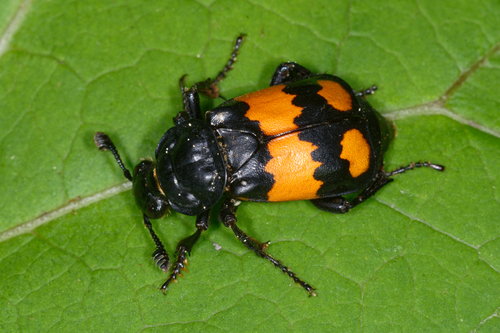
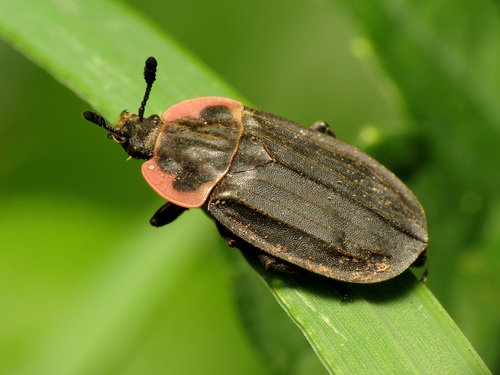
Oiceoptoma noveboracense larvae vary in color from light brown to dark reddish, and have a typically flat, trilobite-like appearance. They are able to move to new locations during their development. Adult Oiceoptoma noveboracense average 13 to 15 millimeters (0.5 to 0.6 inches) in length. On the dorsal side of the pronotum, the first segment of the beetle's thorax, the central area is dark brown to black, while the outer margins are outlined in bright orange-red, also called salmon. The elytra are hardened forewings that protect the fragile hind wings underneath. Attached to the suture running down the middle of the beetle's back, elytra range in color from reddish brown to black. They have a distinctive tooth at the shoulder, and their vertical ridges are very distinct. The elytra apex is rounded on males, and more tapered on females. O. noveboracense has a long line of yellowish-tinted erect setae in the temple regions behind its eyes, and the inner tomora is a ridge-free area. Male metatibiae are enlarged, ranging from moderate to large in size. Oiceoptoma noveboracense is most commonly found in deciduous forests, grasslands, and fields. It less often inhabits marshes, and when it does occur in marshes, the area is typically prone to seasonal inundation that leaves it superficially resembling a dried field habitat. The species' range extends from the Atlantic coast of the Northeastern United States, along the northern edge of the prairies west to the Rocky Mountains, and it may be present as far south as Texas. Oiceoptoma noveboracense is a diurnal species, meaning it is primarily active during the daytime. This beetle produces one generation per year. Reproduction begins in spring, and depending on temperature, approximately 45 days pass from mating to adult emergence from the pupa. Eggs are laid in carrion, so that newly hatched larvae can immediately feed on this substrate. Like most members of Silphidae, adult O. noveboracense typically feed on carrion as well as fly larvae that also feed on carrion. During spring, when mating occurs, adults are commonly found paired with males mounted on females. This position is often maintained for extended periods even when copulation is not actively happening. Typically, males firmly grasp a female's antennae with their mandibles to position themselves for sexual activity. After copulation, the male releases the female's antenna, slides backward onto the female's elytra, and strokes her pronotum with his own antennae. The male then grabs the female's antennae again, and this sequence of behaviors repeats. This activity occurs frequently until the female lays her eggs. Males have not been observed to be sexually active when eggs or instar larvae are present at the carcass. This behavior suggests that males may use this period to ensure they are the father of the offspring of the female they mated with. The medical importance of Oiceoptoma noveboracense has not yet been substantially determined. However, one study found that the species' hindgut, midgut, and associated hemolymph can potentially carry known opportunistic bacterial pathogens. Most of the identified opportunistic pathogens collected were either coliforms or staphylococci.