About Oenothera speciosa Nutt.
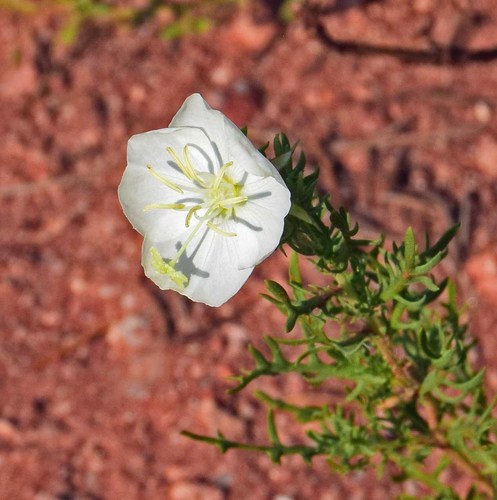
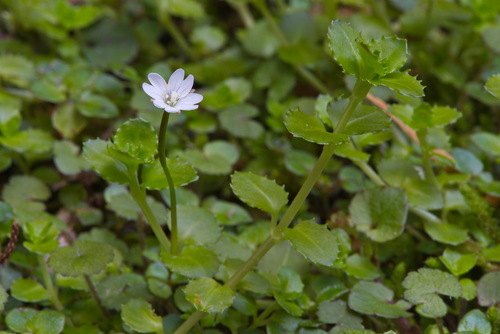
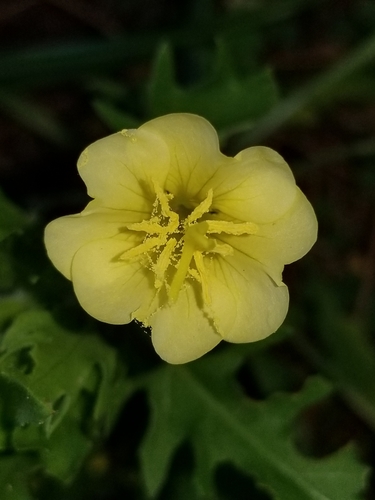
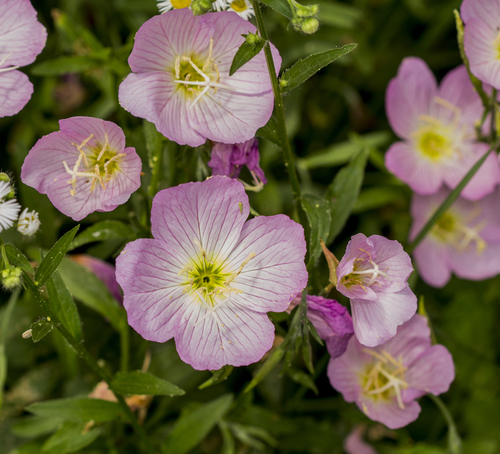
Oenothera speciosa Nutt. is a herbaceous perennial wildflower. Its stems range from glabrous (smooth) to pubescent, and grow up to 50 centimeters (20 inches) in height. Its pubescent leaves are arranged alternately, are sessile with very short or no petiole, and grow up to 10 cm (4 in) long and 4 cm (1+1⁄2 in) broad. Leaves vary in shape from linear to obovate, and have toothed or wavy edges. Single, four-petaled, cup-shaped flowers grow from the upper leaf axils of this species. These fragrant shell-pink flowers bloom from summer into early autumn. The flowers are 4–5 cm (1+1⁄2–2 in) across; they start out white and turn pink as they age. The flower throats, stigmas and stamens are soft yellow. Oenothera speciosa blooms both day and night, but typically opens in the pre-dawn hours and closes when exposed to full sun. Its main blooming period runs from March to July, with occasional fall blooming. Several insect species visit its flowers, with moths being the most common since the flowers are mostly open at night. This species is originally native to grasslands in Kansas, Missouri, Nebraska, northeastern New Mexico, Oklahoma, and Texas. It has become naturalized in 28 of the lower 48 United States, as well as in the Mexican states of Chihuahua and Coahuila, and frequently escapes from cultivation. Its wild habitat includes rocky prairies, open woodlands, slopes, roadsides, meadows, and disturbed areas. It is grown as an attractive garden plant, but it can become invasive, spreading via runners and seeds, so care is required when cultivating it. This drought-resistant plant grows as a groundcover, and prefers loose, fast-draining soil and full sun. It is used as an ornamental plant in temperate latitudes, but it does not survive severe winters. It is sufficiently hardy in United States Department of Agriculture hardiness zones 4 to 9, and in most areas of Central Europe. In Europe, this plant has been reported to cause the death of hummingbird hawk-moths, which get stuck inside the flower while foraging. The green parts of Oenothera speciosa can be cooked or eaten raw in salads, and has a pleasant taste when harvested before flowers develop.