About Oeneis nevadensis Felder, 1867
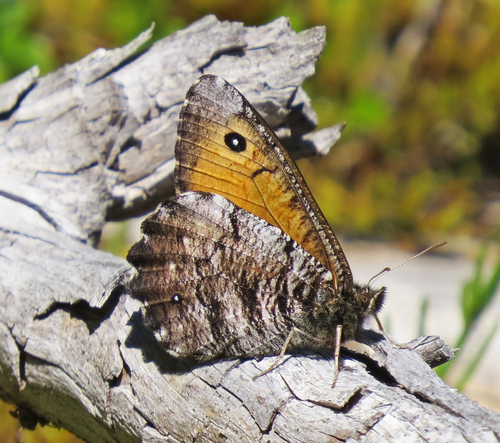
Oeneis nevadensis, commonly known as the great Arctic, has a wingspan ranging from 2 to 2.5 inches (5.1 to 6.3 cm), which makes it the largest western Arctic species. The nominate subspecies O. n. nevadensis has bright orange-brown coloration on the upper side of its wings, with dark brown scalloped wing margins. Males of this subspecies have one to two black eyespots on the forewing, while females have two to three. Males also have a large, dark patch of sex scales on the forewing that extends from the basal area to near the apex; females have dark scaling on the basal area of the forewing. Both sexes have a small eyespot near the tornus of the hindwing. The underside of the forewing matches the coloration of the upper side. The ventral hindwing is uniformly striated in dark brown and gray, and some populations have an irregular dark median band on the hindwing. The costa is whitish. Subspecies O. n. gigas is slightly larger and darker than the nominate subspecies. Subspecies O. n. iduna differs from the other two subspecies by having a much paler upperside. The great Arctic is found almost exclusively in the Cascade Mountains, ranging from southern British Columbia to northern California. O. n. gigas occurs on the southern tip of Vancouver Island, while O. n. iduna occurs in northern coastal California. Its elevation range extends from sea level up to 7,000 feet (2,100 m). Its habitats include forest clearings, open pinewoods, gravel roads, meadows, slopes, and canyons. Along the coast, it is commonly found on bare mountain summits. The great Arctic produces whitish oblong eggs with flat tops. The caterpillar is tan with a black lateral dorsal stripe, and its sides are striped with brown, greenish brown, and white. The caterpillar's head lacks horns, and the posterior end of its abdomen is forked. In its first year, the caterpillar overwinters while partially grown; in its second year, it overwinters as a fifth instar. The host plant of the great Arctic is unknown, but it is believed to belong to the grass family Poaceae.