About Oeneis chryxus Doubleday
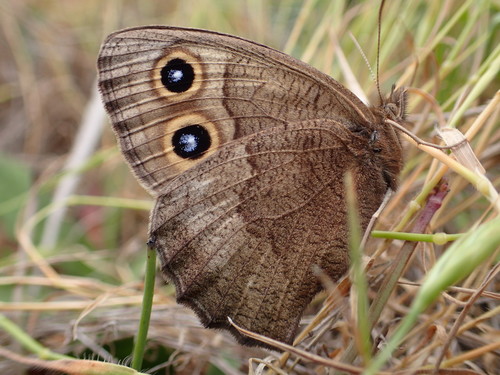
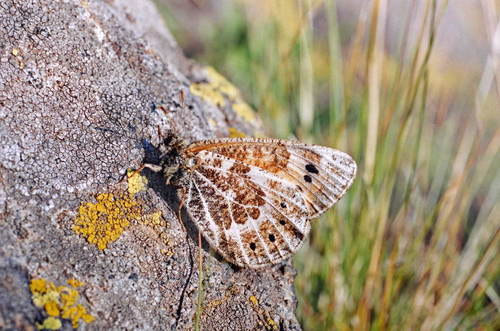
This species, commonly called the brown Arctic butterfly, has the scientific name Oeneis chryxus Doubleday. The upperside of its wings is typically cream to orange brown, with darker brown coloration along the wing edges and at the wing bases. The underside of the hindwings has coarse striation in dark brown and light grey, with a broad, poorly defined dark median band and light grey veins. The upperside of the forewing has two to four black eyespots near the outer margin, while the upperside of the hindwing has zero to two black eyespots. These eyespots are also present on the underside of the wings. The wingspan of Oeneis chryxus ranges from 39 to 54 mm. Adult males can be told apart from females by a dark discal patch on the forewing. Females also have rounder wings than males, while males have more pointed forewings. The brown Arctic butterfly is found across the far northwest of North America, with confirmed occurrences in Alaska, West Alberta, South British Columbia, Idaho, Montana, Wyoming, Colorado, Utah, Nevada, New Mexico, and California. This species generally prefers mountainous, sparsely vegetated environments with short summers. It is often found in prairies and steppes, but may wander to mountaintops and forest edges. It has been conjectured that the species prefers habitats with suitable perching spots, such as fallen trees, and areas sheltered from harsh winds like gulches. Individuals have been observed to be less attracted to sites with 50% to 60% or more plant cover. Males are more likely to be found on elevated ridge tops, and typically favor the highest points of these ridges, while females tend to stay in meadows.