About Oenanthe pimpinelloides L.
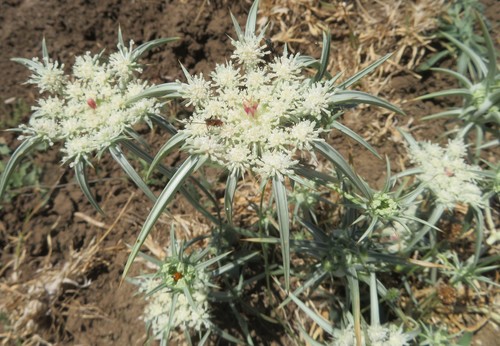
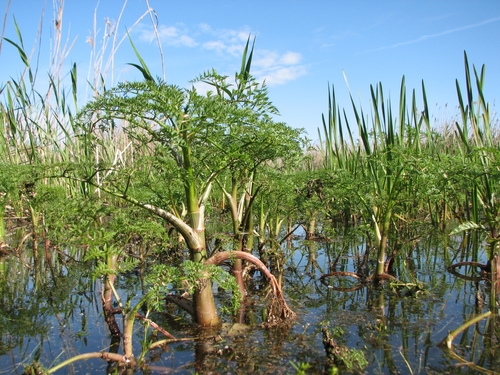
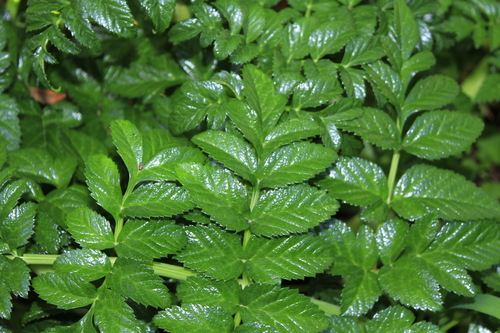
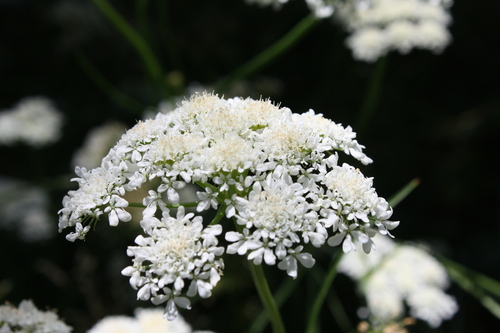
Oenanthe pimpinelloides L., commonly called corky-fruited water-dropwort, is a hairless, upright perennial plant. It has a solid, strongly grooved stem that grows up to 100 cm tall and 0.5 cm in diameter. Ovoid root tubers grow a short distance from the base of the stem. Lower leaves are lanceolate to ovate, twice pinnate, with broad, toothed, cuneate segments up to 55 mm long, and a petiole up to 10 cm long that may exude sparse white latex when pierced. Upper leaves are once- or twice-pinnate, with a leaf blade at least as long as the petiole, and linear, entire lobes 10–30 mm long. Main umbels each hold 6–15 smooth rays 1–2 cm long, which thicken after flowering. A whorl of up to 5 small linear-lanceolate bracts grows below these rays. Peduncles of secondary umbels (umbellules) are longer than the rays and also thicken after flowering, creating distinctively flat-topped fruiting heads. Each umbellule is subtended by 12–20 small, linear bracteoles. In the UK, it flowers from June to August. Terminal umbels produce both male-only and bisexual flowers, while lateral umbels produce only male flowers. Non-fruiting male-only flowers grow on longer pedicels than bisexual flowers. Each tiny flower has 5 pointed green sepals and 5 white petals, with the outermost petals slightly larger, a trait called radiating. It has 5 stamens, and 2 styles that project from the bulbous central stylopodium. The stylopodium secretes nectar onto its surface to attract generalist pollinating insects such as flies. Its fruit is a schizocarp: a hard capsule that splits into two one-seeded mericarps as it matures. Each schizocarp is 3–3.5 mm long, with a prominent ridge on each mericarp. Individual pedicels also thicken after flowering, just like rays and peduncles. For identification, among species in the Oenanthe genus, Oenanthe pimpinelloides has ovoid to globose root tubers positioned some distance from the stem base. Only narrow-leaved water-dropwort also has this tuber shape, but its tubers grow close to the plant base. Due to conservation and wildlife law, you should not uproot the plant to check this character for identification; use other morphological features and habitat context instead. Among British species, corky-fruited water-dropwort is distinctive for its tendency to grow in dry habitats and its flat-topped umbels. Its bracts separate it from narrow-leaved water-dropwort, which has similarly fine foliage. It has frequently been confused with the very similar O. incrassans in southeast Europe, which is sometimes treated as a subspecies of O. pimpinelloides. This species grows in damp to dry grassland, hay meadows, old pastures, and roadsides. It is more resistant to water stress than other Oenanthe species, and is the only water-dropwort that grows in dry lowland habitats across parts of its natural range. While it is usually described as a grassland plant, its habitat is often somewhat ruderal and tends towards scrub. In Sardinia, it grows in myrtle scrub around Mediterranean temporary ponds, and in Turkey it is often found growing under hazel trees. Under the European EUNIS habitat classification system, it is a characteristic species of Atlantic false oat-grass meadows (E2.211), which are restricted to the southern British Isles and western France. This corresponds to MG1 Arrhenatherum elatius in the British National Vegetation Classification, though O. pimpinelloides was omitted from the original description of that community. False oat-grass meadows are characteristic of southern English counties including Somerset and Hampshire, though this community is now most often found on road verges and field margins. A different analogous habitat for this species is EUNIS Mediterranean tall humid grasslands (E3.1), which are widespread across southern Europe as far east as the Black Sea. Its Ellenberg values in Britain are: L = 7, F = 7, R = 6, N = 3, and S = 0. Five insect species are known to feed on corky-fruited water-dropwort in the UK. Three are flies: Kiefferia pericarpiicola larvae form galls on flowers and seeds; Lasioptera carophila (a midge) also forms galls in flowers or stems; and carrot fly can attack the roots. The remaining two are Lepidoptera: Depressaria daucella caterpillars feed among flowerheads, while Agonopterix yeatiana larvae roll leaves and shoots. In New Zealand, where it has no natural enemies, O. pimpinelloides can become a noxious weed due to its vigorous, persistent growth, and may outcompete native eucalypts. Corky-fruited water-dropwort is widely distributed across Europe, ranging from western Ireland and southern Britain to Turkey, and extends into western Asia including Israel, Jordan, Lebanon, and Syria. It also grows south through France, Spain, Portugal, and Morocco. The centre of its global distribution is in France, where it is most common in the south-west, and is classified as Least Concern overall. However, it is classified as Vulnerable inland in regions like Rhône-Alpes, and Critically Endangered at the northern edge of its range in Upper Normandy. In the UK, its natural range is restricted to a few counties including Somerset, Dorset, and Hampshire, where it is locally common. It may be naturalized elsewhere in the country, such as Cambridgeshire. In 2006, several plants were discovered growing around fishermen’s platforms on the bank of a lake at RAF Waterbeach. The following year, around a dozen naturalized plants were found growing on a lawn around a small pond at the British Antarctic Headquarters at High Cross, Cambridge. A new Irish record for the species was recorded at Duncannon in County Wexford in 2006. The closely related hemlock water-dropwort is highly poisonous, so it is often assumed that corky-fruited water-dropwort is similarly dangerous, but there are no recorded cases of it harming humans or livestock, and it frequently grows in hay meadows and pastures with no ill effects on cattle, sheep, or horses. Mrs Grieve described the species as innocuous, and noted that its tubers have a flavour similar to filberts; she did not identify any medicinal properties for it. In Turkey, local people consume it after roasting, cooking it with yoghurt and bulgur wheat, or pickling and cooking it in the winter. It is reported to be used as a digestive stimulant.