About Oenanthe moesta (Lichtenstein, 1823)
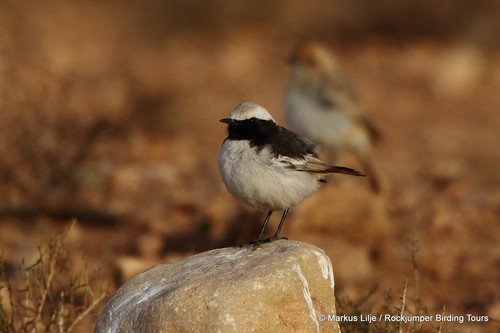
The red-rumped wheatear (Oenanthe moesta, first described by Lichtenstein in 1823) is a compact, large-headed wheatear species that measures 16 cm in length. It has a rufous rump and an entirely dark tail. Males have a grey crown and nape, a black throat and face, and a white supercilium. Their shoulders and back are black, with white fringes along the feathers; the rump and base of the tail are rufous, while the distal part of the tail is black. Females are paler than males, with a rufous crown and cheeks. Juveniles resemble females but are less rufous, and show faint spots and streaks. This species flies low to the ground, with loose, flapping flight that resembles the flight of a skylark. Two subspecies of red-rumped wheatear are currently recognized. Oenanthe moesta brooksbanki, described by Meinertzhagen in 1923, ranges from southern Syria and Jordan to north-western Saudi Arabia and south-western Iraq. The nominate subspecies Oenanthe moesta moesta (Lichtenstein, 1823) is found in North Africa, from the extreme north of Mauritania to coastal north-west Egypt. The red-rumped wheatear avoids true deserts, and is most often found in flat areas, particularly near saline or barren terrain. In Morocco, it occupies more vegetated areas than the desert wheatear, and can also be found on rocky hills.