About Oenanthe lugens (Lichtenstein, 1823)
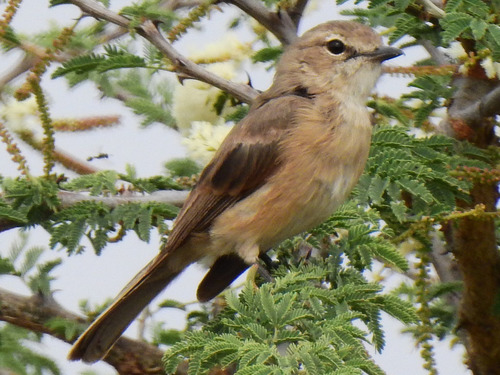
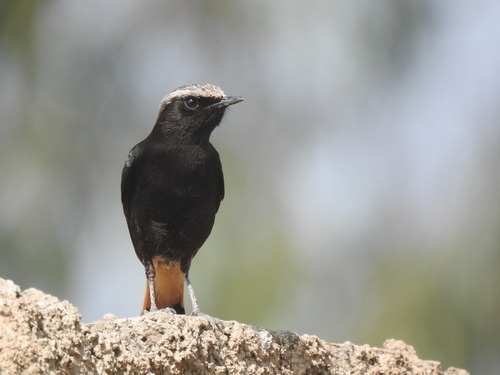
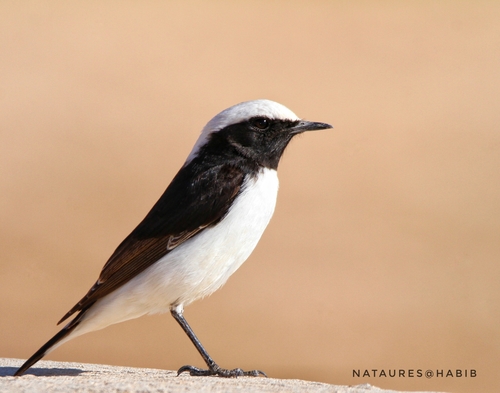
The mourning wheatear, Oenanthe lugens (Lichtenstein, 1823), measures 14–16 cm (5.5–6.3 in) in length and weighs 19–25 g (0.67–0.88 oz). It has distinctive striking black-and-white plumage. Males and females have a similar overall appearance: the crown, nape, chest, and belly are white, which contrasts with the black head, neck, and back. Its tail is mostly white, marked with a black stripe at the tip and a central black marking that forms an inverted "T" pattern, a feature characteristic of wheatears. When at rest, the wings look entirely black, but during flight they show white bases on the flight feathers, creating a distinct white "flag" along the wing. This species has only subtle sexual dimorphism: females have less bold plumage than males. One recognized subspecies, the basalt wheatear O. l. warriae, differs from the nominate subspecies by having mostly black plumage, with only white undertail coverts and a small white patch on the rump. Adult female basalt wheatears have less black, more brown-toned plumage. Another subspecies, the Maghreb wheatear O. l. halophila, displays strong sexual dimorphism: females have grey-brown plumage, unlike the black-and-white plumage of males. The mourning wheatear is native to semi-desert regions of the Middle East, ranging from eastern Egypt to Iran. It primarily inhabits desert environments, and prefers areas with shelter-providing caves, as well as rocky slopes, valleys, screes, cliffs, ravines, dry barren wadis, ridges, and flat plains. It occasionally occurs in villages, lowlands, wastelands, and cultivated fields. It is most commonly found at altitudes between 1,000 and 4,000 metres (3,300 to 13,100 ft).