About Oenanthe isabellina (Temminck, 1829)
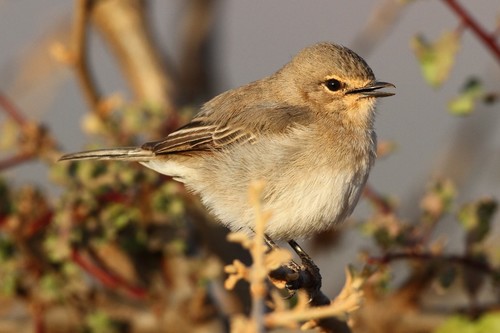
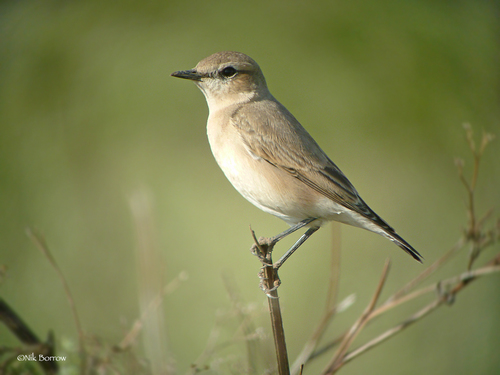
Male and female isabelline wheatears (Oenanthe isabellina) have similar appearances. Their upper-parts are pale sandy brown with an isabelline tinge; isabelline refers to a pale grey-yellow, fawn, cream-brown, or parchment colour. The lower back is isabelline, while the rump and upper tail-coverts are white. Tail feathers are brownish-black with a narrow buff edge and tip, and a large white base. This white base covers more than half the length of outer tail feathers, but only about one third of the length of central tail feathers. The species has a creamy white over-eye streak, and pale brown ear-coverts. The chin is pale cream, and the throat is pale buff. The breast is sandy or isabelline buff, and the belly is creamy white. Under tail-coverts are pale buff, while under wing-coverts and axilliaries are white with dark bases. Wing feathers are brownish-black, tipped and edged with creamy buff. The beak, legs, and feet are black, and the irises are brown. This species measures 16.5 centimetres (6.5 in) in length, making it rather larger and paler in colour than the northern wheatear (Oenanthe oenanthe). It also has a longer beak and paler ear-coverts than the northern wheatear, but the two species are otherwise very similar in appearance and can be confused. Isabelline wheatears moult twice a year: they undergo a complete moult in late summer, and a partial moult of body feathers in mid-winter. Their call note is a chirp, and they sometimes emit a loud whistle. Their song is described as lark-like: it starts with a croaking noise, followed by various whistles, and includes mimicry of the voices of other birds. The isabelline wheatear is a migratory species with an eastern Palearctic breeding range that extends from Southern Russia, the Caspian region, the Kyzyl Kum Desert, and Mongolia to Afghanistan, Iran, Iraq, Saudi Arabia, Syria, Jordan, and Israel. It winters in Africa and northwestern India. It has been recorded as a summer vagrant in Greece, Cyprus, Algeria, and Tunisia. During the breeding season, the isabelline wheatear lives in open country, barren tracts of land, arid regions, steppes, high plateaux, and the lower slopes of hills. In its winter range, it occupies similar habitats: semi-arid regions, open country with sparse scrub, and the borders of cultivated areas, and it shows a particular preference for sandy ground.