About Oenanthe hispanica melanoleuca (Guldenstadt, 1775)
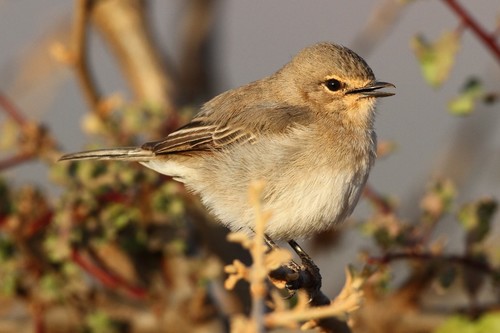
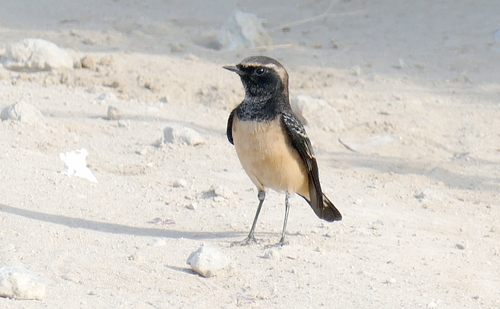
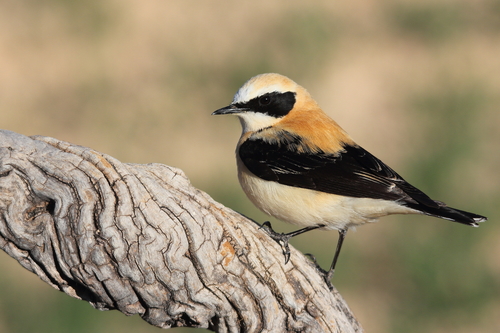
This subspecies, Oenanthe hispanica melanoleuca, has distinct plumage traits that vary by sex and season. Breeding males have a white or nearly white forehead and crown, a buff-colored mantle, and wings that are blacker than those of the northern wheatear. Their underparts are white with a buff tinge, while their back, upper tail coverts, and most of the tail are white. A black mask runs from the ear coverts to the bill, and the throat may be either black or white. In autumn and winter, the head and mantle are distinctly buff, as are the underparts (including the throat of non-black-throated individuals), though the intensity of the buff color varies. Except for the central pair, tail feathers are much whiter than they are on the northern wheatear, with white often extending to the tip along the inner web. Females are overall browner than males, but share the characteristic white lower back, and their seasonal plumage changes are less pronounced. Male Oenanthe hispanica melanoleuca can be distinguished from male eastern black-eared wheatears by more buff-tinged upperparts that create a less clearly defined black-and-white pattern. The black mask of this subspecies stops at the base of the bill, rather than extending slightly above it. Black-throated individuals of this subspecies have less black coverage on the throat and face than eastern black-eared wheatears, and the black edge generally ends less abruptly. Females of this subspecies differ from female eastern black-eared wheatears by being a warmer overall brown.