About Oenanthe fusca (Blyth, 1851)
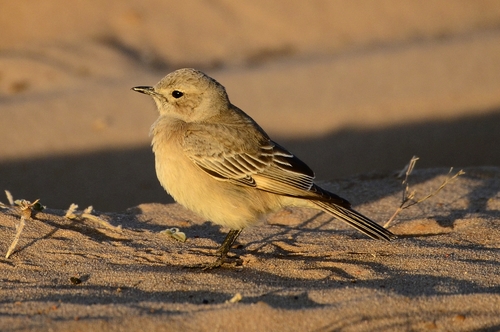
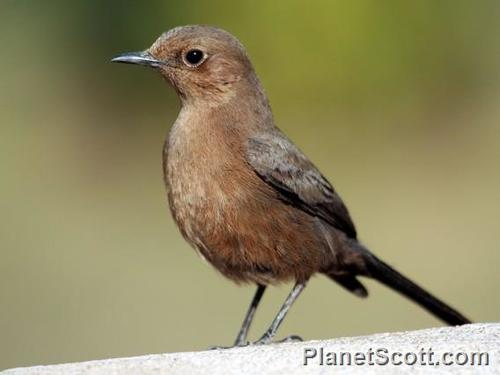
The brown rock chat, scientifically named Oenanthe fusca (Blyth, 1851), is approximately 17 centimeters long, making it larger than the similar-looking Indian robin. Its entire body is uniformly rufous brown, with wings and tail in a slightly darker brown shade. The brown coloration on its underside gradually changes to dark grey-brown at the vent. It has a slender beak that is slightly curved at the tip. On this bird, the second primary feather is the longest, and its tail has a rounded shape. In flight, it looks similar to a female blue rock thrush. Male and female brown rock chats cannot be told apart when observed in the field. This species is nearly endemic to India, distributed north of the Narmada River. It ranges west to Gujarat, where it occurs mainly in Kutch, though its range extends further south, and east to Bengal. To the north, its range is bordered by the Himalayas, where it lives up to an elevation of about 1300 meters in the foothills. Its distribution also reaches into northern Pakistan, extending west as far as the Chenab River. While the species is largely resident, some populations move in response to weather conditions. In the Himalayan foothills, it moves to higher elevations in summer; it appears in Dehra Dun in spring and leaves before winter begins. The brown rock chat has also been recorded in Nepal. It is a common species, but has a very patchy distribution. It is usually found alone or in pairs, in rocky areas or on old buildings.