About Oenanthe deserti (Temminck, 1825)
Scientific name: Oenanthe deserti (Temminck, 1825)
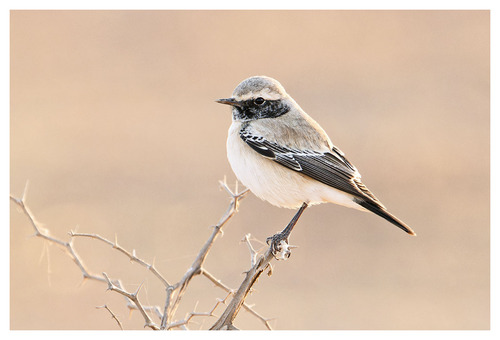
Description: For adult male desert wheatears, the head and nape are pale sandy-grey, with individual feathers tipped grey. The mantle, scapulars, and back are a similar but noticeably richer shade. The rump and upper tail-coverts are pale buff. The basal third of the tail feathers is white, while the remaining portion is black with a pale buff tip. A pale buff curved stripe over the eye extends backward. Feathers on the chin, throat, lores, and ear-coverts are black with white tips. The breast and flanks are sandy-buff, and the belly and under tail-coverts are creamy-white with a light buff tinge. The axillaries and under wing-coverts are black with white tips. The primaries have black outer webs, tipped and edged with white, and pale brown inner webs edged with white. The secondaries share this pattern, but have broader white edges on both webs. Adult desert wheatears measure around 15 centimetres (5.9 in) in length, and weigh between 15 and 34 grams (0.53 and 1.20 oz).
Females have similar plumage to adult males, but their rump and upper tail-coverts are more sandy brown; their lores, chin, and throat are pale buff, and the dark sections of the tail are brownish-black. Juveniles resemble adult females, but the feathers on their upper body have pale centres and brown tips, which creates a more distinctly speckled appearance. This species undergoes a single annual moult in late summer. By the following spring, feathers become quite abraded, and the white tips tend to wear away, leaving the bird with richer overall colouring. The beak, legs, and feet are black, and the irises are dark brown.
Distribution and habitat: The eastern race of the desert wheatear breeds across a wide area of Asia, stretching from the Middle East and Saudi Arabia through Iran, Baluchistan, Afghanistan, the south Caucasus, Turkestan, the Tarbagatai Mountains, the Altai Mountains, and northwestern Mongolia. Birds from this breeding range migrate south to overwinter in northeastern Africa, the Arabian peninsula, Iraq, and Pakistan. The western race breeds in North Africa, from Morocco and Rio de Oro to the part of Egypt west of the River Nile. This population is mostly resident; however, in Morocco, birds in the south and east of the country migrate, while those in the southwest typically do not.
The desert wheatear inhabits barren open countryside, including steppes, deserts, semi-arid plains, saltpans, dried river beds, and sandy, stony, or rocky wastelands. It can be found at altitudes up to 3,500 metres (11,500 ft). During the winter, it may also use cultivated land when this is mixed with bare open areas of countryside. The desert wheatear is an occasional vagrant to the United Kingdom. In October 2012, a migrating female blown off course was sighted in an Essex sandpit; only a few weeks later, another individual was spotted at the RSPB Loch of Strathbeg reserve in Scotland.