About Oenanthe aquatica (L.) Poir.
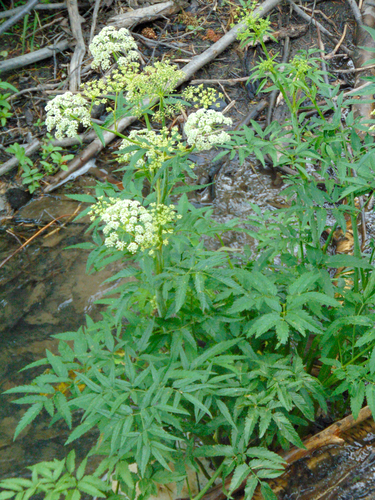
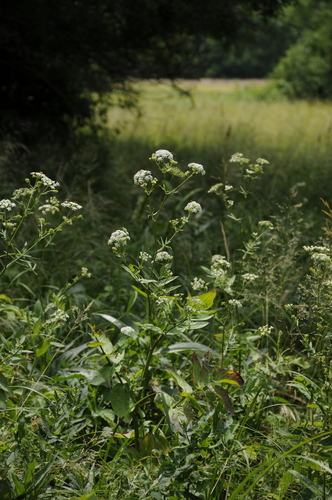
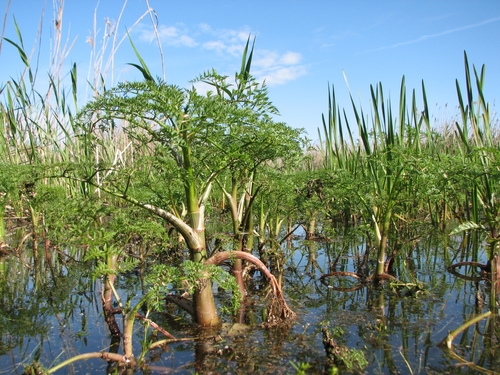
Fine-leaved water-dropwort (Oenanthe aquatica (L.) Poir.) is a hairless, annual to perennial herb that reaches about 150 cm in height. Young plants grow tubers that disappear by mid-summer. Its stem is hollow and striated, normally around 1 cm in diameter, but can exceptionally reach 8 cm; it grows either erect or sprawling, and roots at the nodes of any submerged sections. Very large sprawling specimens have been found with stems up to 2 m long.
Upper aerial leaves are 2- to 3-pinnate, finely divided into lanceolate (sword-shaped) to ovate leaflets that grow up to 5 mm long. Lower leaves are 3–4 pinnate, with very narrow thread-like leaflets when growing under water, but flat, ovate leaf segments when emergent. Leaf stalks form a sheath around the stem at their base.
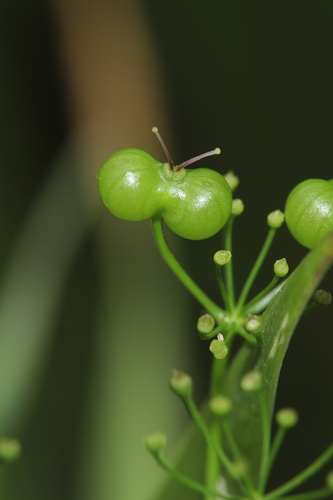
In northern Europe, this species flowers between June and September. Inflorescences grow from leaf axils or the tip of the stem, forming a compound umbel made of 6–16 smaller rounded umbels around 1–2 cm in diameter, each holding numerous white flowers. There are no bracts on the main umbel, and 4–8 small, lanceolate bracteoles at the base of each secondary umbel. Plants are monoecious, with most umbels bearing both bisexual and male flowers. Each flower has 5 sepals, 5 unequal petals (with outer petals slightly larger), 5 stamens and 2 styles. After flowering, the umbel rays (stalks of individual umbels) and flower pedicels do not thicken, and umbels do not become flat-topped when fruiting. Fruits are 3–5.5 mm long, ovoid, with prominent ridges. When mature, each fruit splits into two 1-seeded mericarps. Reproduction is entirely by seed; well-grown plants can produce as many as 40,000 seeds.
When compared to other water-dropworts in Britain, fine-leaved water-dropwort has particularly finely divided leaves (up to 4-pinnate) with small, lobed leaflets. It is most easily confused with river water-dropwort, which was long considered the same species. Submerged specimens of the two are not similar: river water-dropwort grows fully submerged in running water, with diamond-shaped leaflets, but emergent plants of the two species are very similar. The most reliable way to separate them is by fruit: O. aquatica fruits are ovoid and no more than 4.5 mm long, while O. fluviatilis fruits are cylindrical and longer than 5 mm.
The native range of fine-leaved water-dropwort extends from Ireland in the west eastwards to central Siberia, and from the more southerly parts of Scandinavia southwards to the Mediterranean basin. It is rarely found as an introduction outside this native range, but there are recorded introductions in Washington, D.C. and New Zealand, where it is not considered invasive. Although it once occurred in a few locations in Spain, it is thought to be extinct there now. Globally, the IUCN lists this species as Least Concern (LC), and records its populations as stable. In Britain, it occurs mainly in the lowlands of eastern England (from Kent to Yorkshire) and western England (from Somerset to Lancashire). It is rare in Wales, and absent from Scotland. In Ireland, it is widely distributed across all lowland areas. It has declined slightly in abundance in Britain over the last 50 years, but still retains Least Concern status. In many British counties it is listed as an axiophyte, meaning it is considered a plant of conservation significance. It is widespread and common in France, with an overall status of Least Concern, although it is classified as Vulnerable (VU) in Corsica and Endangered (EN) in two French départements: Midi-Pyrénées and Provence-Alpes-Côte d’Azur. In Germany, where it is called Großer Wasserfenchel (Great Water Fennel), it is considered an indicator of natural floodplain vegetation, and efforts to restore ecosystem function on the Danube have used this species as a measure of success. In the former Czechoslovakia, fine-leaved water-dropwort is very common, occurring predominantly in shallow reservoirs, oxbows and temporary pools up to 640 m above sea level in the Brdy hills. It can become very abundant, reaching pest status, in pools with a fluctuating water level during the year after a drainage event.
Fine-leaved water-dropwort is strictly a wetland plant, occurring in a wide variety of habitats that range from full sun to medium shade, fresh to slightly brackish water, and low to fairly high nutrient status. Its Ellenberg values in Britain are L = 7, F = 10, R = 7, N = 6, and S = 0. Its main habitat across its range is reed swamp (European C5.1a "tall helophyte beds"), where it is generally scarce but sometimes grows in abundance after reeds are cut or disturbed. It is generally more abundant in pools with a fluctuating water level, where it can germinate and grow rapidly on bare mud in summer. Other habitats include ditches, canals, streams, rivers, wet woodland, and degraded mires. Its recorded National Vegetation Classification communities include W1 grey willow, W5 alder and W6 crack willow woodlands; OV30 drawdown zone vegetation; S4 common reed, S12 reedmace and S28 reed canary-grass reedbeds; and S27 marsh cinquefoil bog. It sometimes grows on silty, mineral soils in locations such as farmland ponds, but it is more often found on fenland peat. It is a lowland plant, reaching up to around 200 m above sea level in Shropshire, Britain, and occurs at higher altitudes elsewhere in Europe (for example, Zieringser Teich is at 520 m).
Like all umbellifers, fine-leaved water-dropwort has unspecialised flowers that are pollinated by a variety of insects. In Britain, the Database of Insects and their Food Plants lists eight insect species that feed on this plant. Three are beetles (Prasocuris phellandrii, Hypera adspersa and H. arundinis), two are weevils (Lixus iridis and L. paraplecticus), one is a midge (Lasioptera carophila), and two are micro-moths (Depressaria daucella and D. ultimella). These insects create galls in the stem, leaves or flowers, or their larvae browse on foliage or flowers. None of these insect species feeds exclusively on fine-leaved water-dropwort.
Because of the risk of poisoning, fine-leaved water-dropwort is not widely used. Its fruits are reputed to cause vertigo, drunkenness and narcotic symptoms, and the plant can easily be confused with more deadly related species such as hemlock water-dropwort. Even so, ethnobotanists have recorded its use to treat a variety of medical conditions, including chronic pectoral diseases, dyspepsia, fevers and ulcers.