About Oedera capensis (L.) Druce
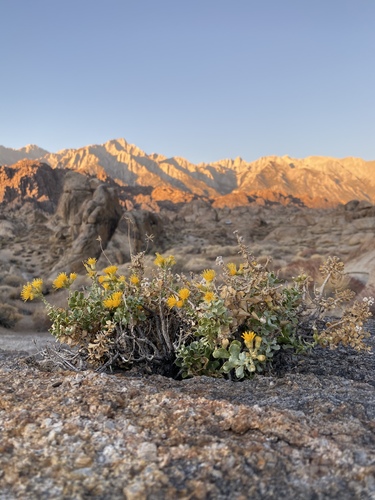
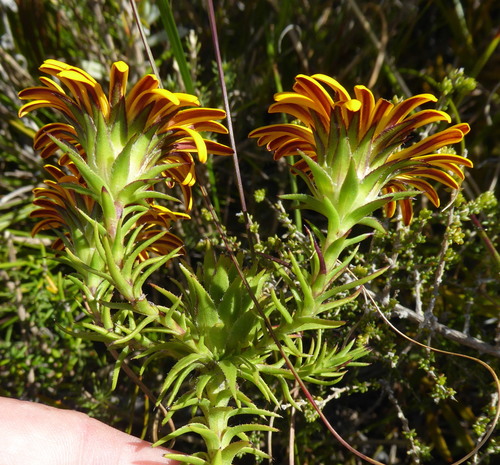
Oedera capensis (L.) Druce is a prickly, sprawling shrublet that reaches around 25 cm (9.8 in) in height. It grows between two and six branches below the flower heads produced in the previous season. Stems are densely covered in alternately arranged leaves, which are mostly hairless, erect to recurved, flat, and leathery. The leaves are narrow triangular, 5–25 mm (0.20–0.98 in) long and 2–6 mm (0.079–0.236 in) wide, with glands and silky hairs along their edges. Usually nine (and rarely ten or eleven) individual flower heads are clustered tightly at the tip of branches, appearing at first glance to be a single flower head that is mostly 20–25 mm (0.79–0.98 in) in diameter. The central flower head contains only yolk yellow disc florets. The remaining outer flower heads have disc florets plus a row of yolk yellow ray florets, which are burgundy on their reverse side in areas that do not touch other flower heads. A full cluster of cropped heads usually has 30 to 40 ray florets total, and a few shorter ray florets sometimes grow in areas where individual heads touch each other. The involucre that surrounds the entire clustered head is made up of several whorls of green, leaf-like bracts. These bracts are usually 2–3 mm (0.079–0.118 in) wide, lanceolate, widest at their midlength, and have a prominent rib along their midline. The inner row of bracts surrounding the entire cluster has dense, silky hairs on the lower part of their edges. The involucral bracts between individual heads are thin and papery. The pappus is made up of a circle of scales around the tip of the cypselas. Flowering typically occurs from June to September, and rarely extends into December. This species has seven sets of homologous chromosomes, with a chromosome count of 2n=14. Oedera capensis grows on dry stony slopes and flats, roadsides, and sandy areas, ranging from Albertinia to the Cape Peninsula. In a germination experiment, 20% of cypselas germinated after exposure to smoke, while only 5% sprouted without smoke exposure.