About Oecophylla smaragdina (Fabricius, 1775)
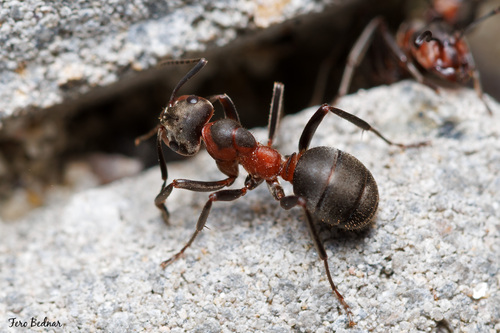
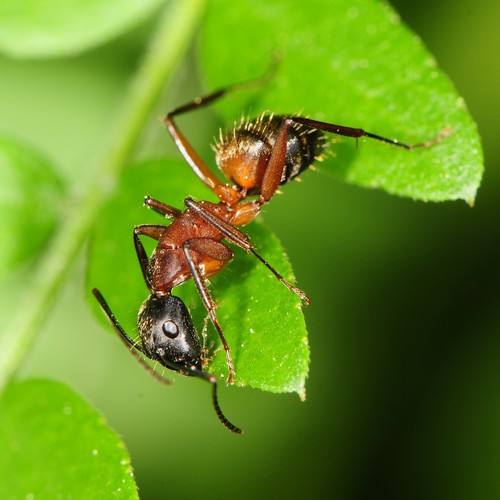
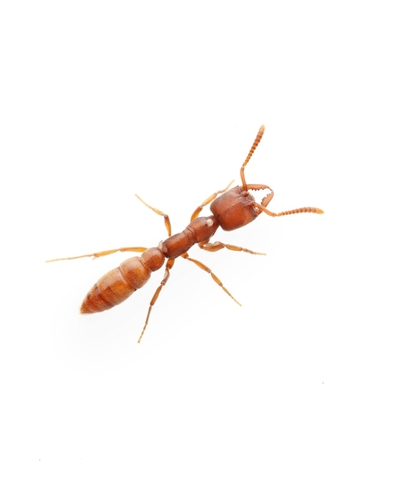
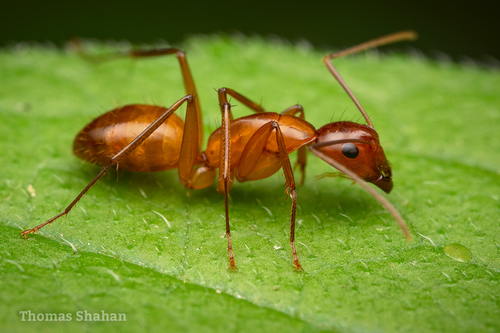
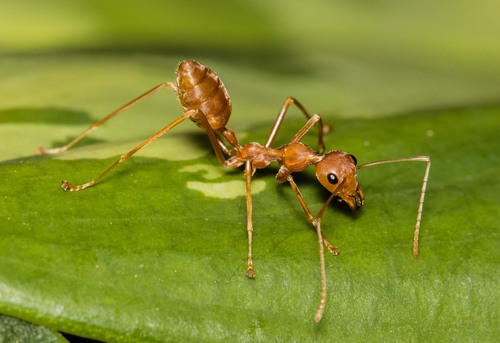
Oecophylla smaragdina, commonly known as weaver ant, was first described by Fabricius in 1775. Worker individuals fall into two size castes: minor workers and major workers. Minor workers are 5–7 millimetres long, most often orange in colour, and their tasks include caring for larvae and farming scale insects to obtain honeydew. Major workers are 8–10 millimetres long, also mostly orange, and have long, strong legs and large mandibles; they handle foraging, as well as nest assembly and expansion. Mature queens are typically 20–25 millimetres long, and are normally greenish-brown. This colouration gives the species its specific epithet smaragdina, which means emerald in Latin. This species has a widespread distribution across tropical Asia and Australia, with a range that extends from India, through Indonesia and the Philippines, to the Northern Territory and Queensland in Australia. It is an arboreal species that builds its nests within tree foliage. Nest construction takes place at night: major workers weave the exterior of the nest, while minor workers complete the interior structure. An ant colony may hold several nests within a single tree, or spread its nests across multiple adjacent trees. Colonies can grow to contain up to half a million individuals, with one recorded colony occupying 151 nests across twelve trees. Each colony has only one queen, who resides in one of the colony's nests, and her progeny are carried to the other nests of the colony. The average lifespan of a mature Oecophylla smaragdina colony is eight years. This weaver ant species is an important component of tree canopy ecosystems in humid tropical regions. Weaver ants prey on insects and other invertebrates, with most prey consisting of beetles, flies, and hymenopterans. They cannot sting, but their bite is painful, and they can secrete irritant chemicals from their abdomens into the bite. In this species, antennal lobe glomeruli are arranged in clusters, which appears to be a common feature across many Hymenopterans, including ants and honeybees. In Singapore, colonies are often found on sea hibiscus and great morinda trees. These trees produce nectar to attract the ants, and in return, the ants protect the trees from herbivorous insects. In Indonesia, trees that commonly host Oecophylla smaragdina colonies include banana, coconut, oil palm, rubber tree, cacao, teak, jackfruit, mango, Chinese laurel, petai, jengkol, duku, rambutan, jambu air, and kedondong. The ants also tend aphids, scale insects, and other homopterans to feed on the honeydew these sap-sucking insects produce, particularly in tree canopies connected by lianas. To maintain this relationship, they drive away other ant species from the canopy areas where their tended homopterans live. The species also forms an association with the larvae of certain blue butterflies in Australia. The common oak-blue, bright oak-blue, and purple oak-blue are obligate associates of this weaver ant, and only exist in regions of Australia where Oecophylla smaragdina is established. The ants may build special shelters near their nests to protect these butterfly larvae. A number of jumping spider species form myrmecophilic associations with Oecophylla smaragdina. Cosmophasis bitaeniata uses aggressive chemical mimicry to disguise itself as a weaver ant, allowing it to enter ant nests to prey on ant larvae. This jumping spider also lays its own eggs near the nest, so newly hatched spiderlings have easy access to ant larvae. Another jumping spider, Myrmaplata plataleoides, is a Batesian mimic of this weaver ant. It mimics the ant visually: it has contracted body parts that create the illusion of a hymenopteran body shape, and two black spots that mimic extra eyes on the side of its head. It also steals ant brood to acquire the colony's scent, but it generally avoids approaching weaver ant nests directly. The larvae and pupae of Oecophylla smaragdina have a range of human uses. They are collected and processed into bird food and fish bait in Indonesia, used in traditional Chinese and Indian medicine, and consumed as a delicacy in Thailand and other countries. In Java, Indonesia, the ant larvae and pupae are called kroto, and are harvested commercially as food for captive songbirds and as fishing bait. Songbirds are very popular in Java, and ant larvae provide a balanced diet rich in proteins, minerals, and vitamins. Kroto is sold in pet shops, and can also be collected fresh from rural areas. When used as fish bait, the larvae are mixed with chicken eggs, maize, beans, and honey. In some regions of India, adult ants are used in traditional medicine as a treatment for rheumatism. An oil made from adult ants is used to treat stomach infections, and is also used as an aphrodisiac. In Thailand and the Philippines, the larvae and pupae are eaten, and their flavour has been described as creamy, sour, and lemony. Across parts of the species' range, living Oecophylla smaragdina colonies are used as a natural form of pest control for crops. Crops that have been protected this way include cowpea, cashew, citrus, mango, coconut, cocoa, and coffee. The oldest written record of using these ants for pest control dates to 304 AD in China, where they were used to manage pests in citrus trees. These ants are aggressive towards humans, and in Sri Lanka, the practice of using them for pest control in coffee cultivation was abandoned because harvesting coffee beans proved too painful for workers.