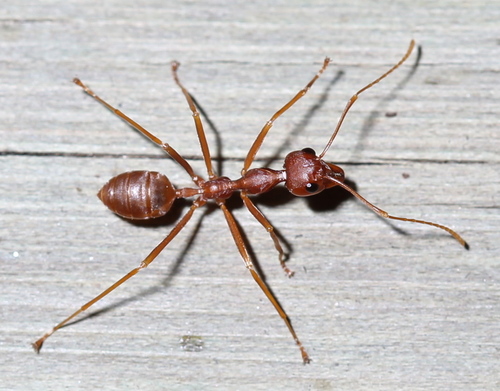
About Oecophylla longinoda (Latreille, 1802)
Worker individuals of this species are fairly large ants, measuring 6 mm (0.24 in) in length. Their antennae have twelve segments, with the first segment longer than the combined length of the second and third segments. The clypeus, located at the front of the head, is large and convex, and overhangs the outer edge of the mouthparts. Their large mandibles bear long triangular teeth, which cross over one another when the ant is at rest. Body color ranges from orangeish-brown to dark brown. The thorax is covered in fine fine pubescence, while the abdomen is covered with short erect hairs. Glands at the tip of the abdomen produce pheromones. The feet have suction pads that allow these ants to cling firmly to surfaces. This weaver ant is widely distributed across the rainforests of sub-Saharan Africa. It occupies the upper canopy; a single colony can dominate the crown of one tree, or spread across multiple trees. After her nuptial flight, a newly mated queen establishes a new colony in a secluded area of the canopy. Initially, she guards the eggs and cares for developing larvae on her own, feeding the larvae from her own bodily reserves and does not leave to forage. She may lose as much as 60% of her body weight during this founding stage. Once fully grown, the larvae pupate, and adult workers finally emerge approximately thirty days after the eggs were laid. After workers emerge, they take over nest construction and brood care, and the queen focuses exclusively on egg laying, producing around one hundred eggs per day. A colony of Oecophylla longinoda weaver ants is made up of a large number of nests, which ants can move freely between. Nests are constructed by binding leaves together with silk, which is produced by final-instar larvae. The queen lives in one of these nests, while workers use the remaining nests to inhabit and care for the brood. The ants occupy a three-dimensional territory in the treetops. They aggressively repel other ants of both their own and other species, and typically create a "no-ants-land" along the boundary where their territory meets that of another colony. They are voracious predators, foraging for insects and other arthropods both on the ground and in trees, and cooperate with one another to subdue large prey. They also feed on honeydew produced by scale insects, and maintain herds of scale insects to secure this food source. O. longinoda is a natural enemy of the coconut bug Pseudotheraptus wayi, a pest that has caused up to 67% loss of coconut crops in Tanzania. This weaver ant competes with other ant species that live in coconut palms, and is sometimes displaced by the ground-dwelling big-headed ant Pheidole megacephala. Even so, the weaver ant is a much more effective biological pest control agent. For this reason, baits are used to selectively control P. megacephala, allowing weaver ants to thrive and manage populations of coconut bugs.