About Oecanthus fultoni Walker, 1962
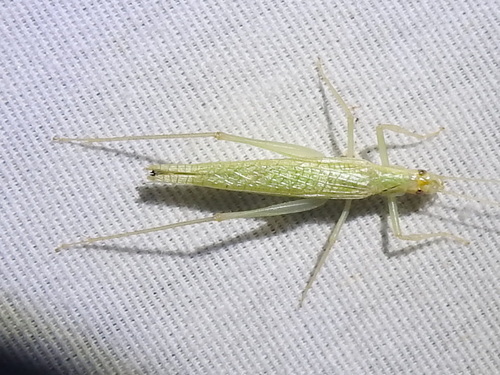
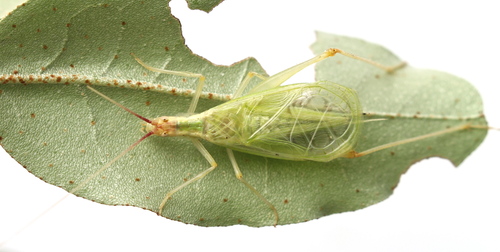
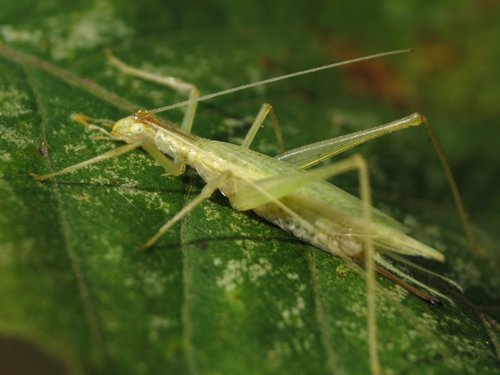
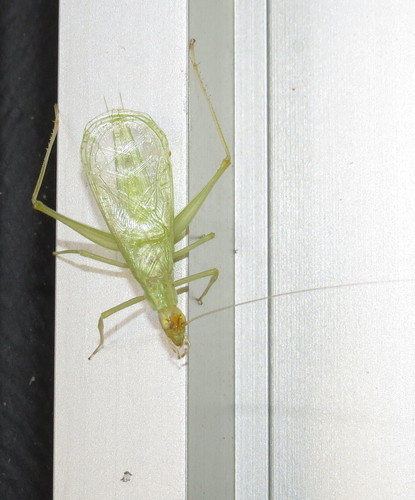
This species measures 15 to 18 millimeters (0.6 to 0.7 inches) in length, with a light green body and translucent light green wings. It has round or oval black marks covering roughly half the length of its first and second antennal segments. Its antennae are longer than its body, and it has a small head. Its eggs are pale yellow, kidney-shaped, and 3 millimeters long. Nymphs are pale, slender, have incompletely developed wings, and gain their full wings slowly over development. The species produces one generation per year.
Oecanthus fultoni was long confused with Oecanthus niveus, a species first described by entomologist Charles De Geer in 1773, until entomologist Thomas J. Walker recognized it as a distinct species in 1962. In the far western United States, where Oecanthus fultoni occurs alongside Oecanthus rileyi (the two are sympatric), this species was historically misidentified as O. rileyi. O. fultoni and O. rileyi are the only two Oecanthus species in the United States that produce a regular chirp, but they differ in chirp rate per minute, and O. rileyi chirps more loudly. O. fultoni chirps faster in areas west of the Great Plains. Only males produce chirps, and they often chirp in groups.
American novelist Nathaniel Hawthorne commented on the species' chirps, saying, "If moonlight could be heard, it would sound just like that." Film and television producers often add this species' chirps to soundtracks to indicate a scene is set on a quiet summer night.
In terms of habitat, this species is found across most of the United States, excluding the southeastern portion of the country. It inhabits shrubs, vines, fruit trees, broadleaved trees, and oaks, and is rarely found in grass. Adult Oecanthus fultoni are active from mid-July to mid-November. The crickets sometimes perch so high in oak trees that their chirp is the only way to identify their presence.