About Oecanthus dulcisonans Gorochov, 1993
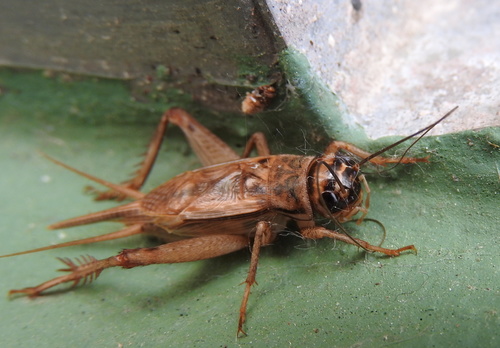
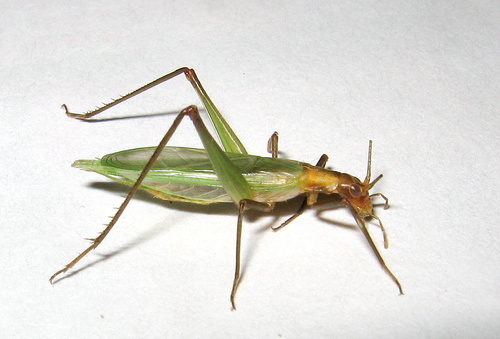
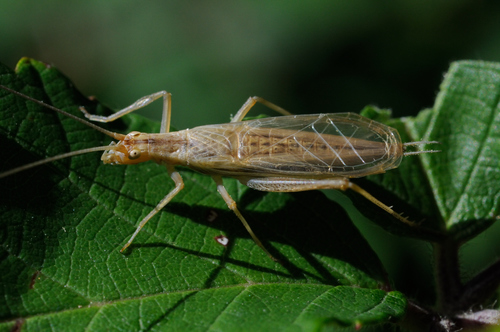
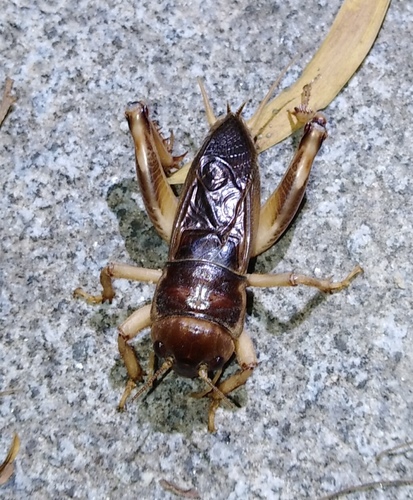
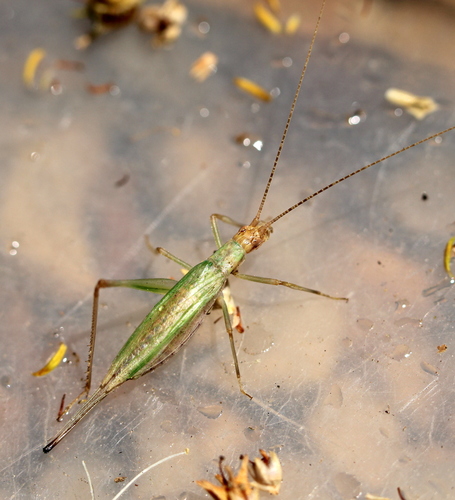
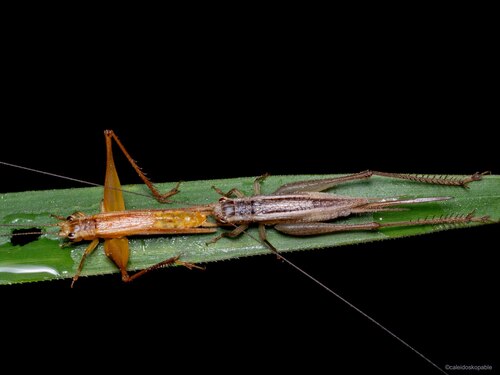
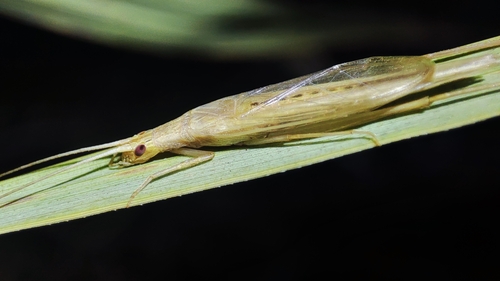
Adult males of Oecanthus dulcisonans Gorochov, 1993 reach 13–15 millimetres (0.51–0.59 in) in length, while adult females grow to 14–16 millimetres (0.55–0.63 in). The species has an overall yellowish body color. Its long forewings completely cover the abdomen, and its hind wings are distinctly longer. Oecanthus dulcisonans can be distinguished from the closely related O. pellucens by its larger body size, different sternal plate shape, and distinct male genitalia. Cordero et al. have investigated these morphological differences between the two species. The characteristic calling song of Oecanthus dulcisonans is one of the most useful traits to tell it apart from O. pellucens. O. dulcisonans produces a strong, melodious, continuous trill, while O. pellucens produces evenly spaced, discrete trills that last 0.5 to 1 seconds each. Additionally, the peak song frequency of O. dulcisonans is slightly higher than that of O. pellucens. Both species are difficult to locate using only the unaided human ear. The insects can change the elevation of their forewings, and the song reverberates through tall grass and reeds, making it hard to identify the sound's source. This species is found in several Tyrrhenian coastal regions of Italy, as well as on Sardinia and Sicily. It was originally reported from Saudi Arabia, and is also present in the Canary Islands. In the Mediterranean region, its geographic range overlaps with the range of its close relative O. pellucens. Studies note that O. dulcisonans prefers to sing from trees, while O. pellucens prefers tall grass, such as the vegetation that grows along small streams. Oecanthus dulcisonans is a thermophilic and heliophilic species that is not particularly habitat-restricted, and can be found in both wet and xeric environments.