About Odontopera bidentata (Clerck, 1759)
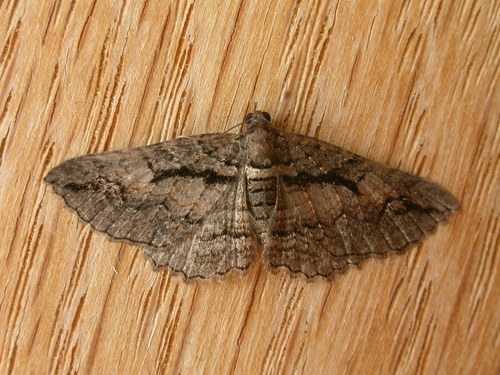
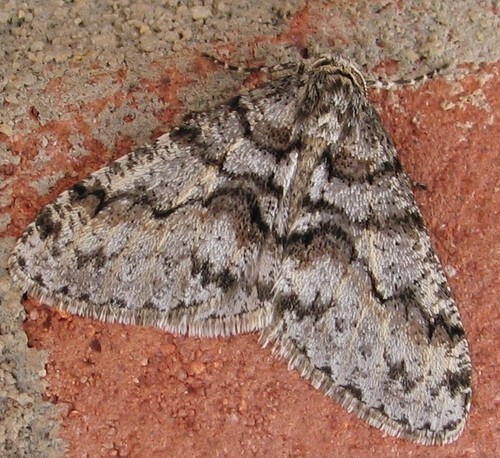
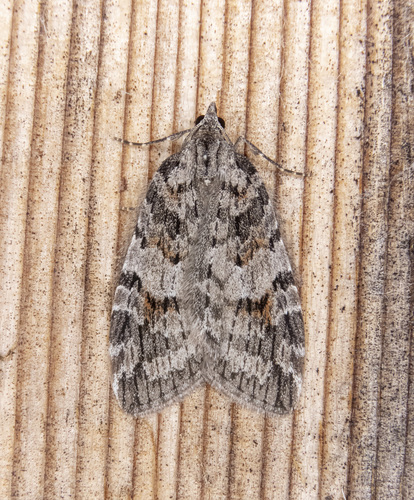
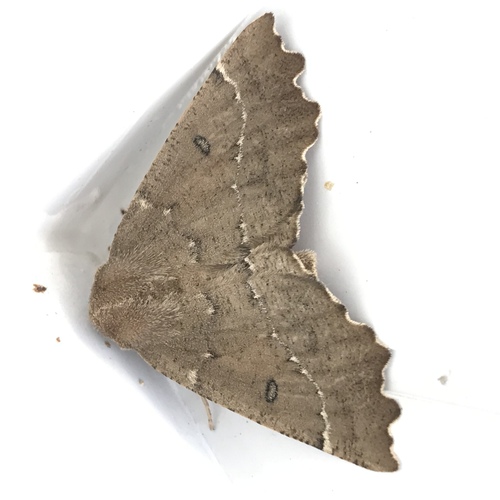
The wingspan of Odontopera bidentata is 46–50 mm. The forewing ground colour is most often grey-brown. The similarly coloured midfield is bordered by blackish crossbars, which are often partly white. At the wing edge below the apex, there are two characteristic protruding teeth, which give the species its scientific name: the name comes from Latin, where bi means "twice" and dentatus means "toothed". The outer dark crossline of the forewings continues across onto the hindwings. All wings have a ring-shaped dark discal spot, and the thorax is covered in hair. This is a highly variable species; wing colour can range from whitish through buff and brown to black, and may sometimes show variegation. However, it is always easy to identify by the white discal spot on each wing and the characteristic ragged margin of the wings. Last instar caterpillars are most often brownish, though other colour variations also occur. Their key identifying features are two small humps on the penultimate body segment, as well as two dark capsule-like protrusions on the head. Adults fly at night during May and June (this flight season refers specifically to the British Isles, and may differ in other parts of the species' range) and are attracted to light. Caterpillars are green or brown, have a twig-like appearance, and feed on a wide variety of plants. This species overwinters in its pupal stage. Odontopera bidentata is a common species found in northern and central Europe, including the British Isles, and extends through Russia to the Urals. It is also widespread across Siberia, the Amur-Ussuri region, and extends to the Kuril Islands and Japan.