About Ocypus olens (O.F.Müller, 1764)
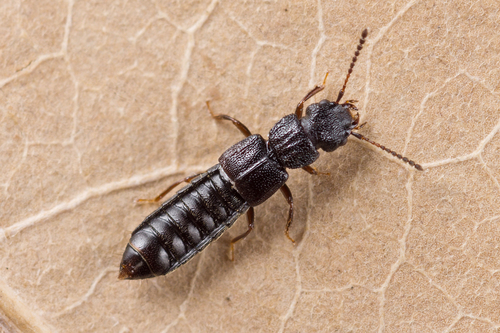
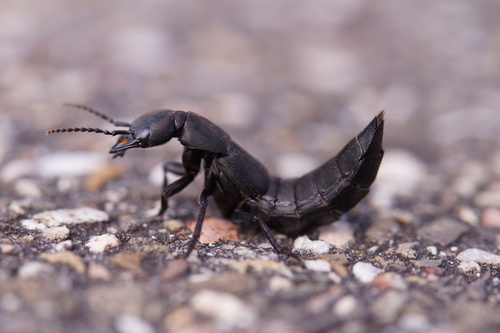
Ocypus olens is a species of black beetle with a long body. It reaches about 20–32 mm (13⁄16–1+1⁄4 in) in length, making it one of the larger beetles found in Europe. Its hard wing covers, called elytra, are short and only cover the thorax, leaving all abdominal segments exposed. The beetle has powerful abdominal muscles, and each abdominal segment is covered with a hardened sclerotized plate. While it has functional wings and is capable of flight, it rarely uses them. The entire body is covered in fine, black hairs. Ocypus olens is well known for its defensive threat display: when disturbed, it raises its long exposed abdomen and opens its jaws, in a posture similar to that of a scorpion. Though it has no sting, it can deliver a painful bite with its strong, pincer-like jaws. It also releases a foul-smelling defensive secretion from a pair of white glands located at the tip of its abdomen. This is a very common, widespread beetle that occurs across most of Europe and North Africa. It has also been introduced to parts of the United States and Canada, including Oregon, Washington, California, and portions of British Columbia. It favors damp habitats, and can be found active from April to October in meadows, heathland, moorland, woodlands, hedgerows, parks, and gardens. During the day, it typically shelters under logs, stones, or leaf litter. Mating for Ocypus olens occurs in autumn. Females lay eggs 2 to 3 weeks after their first mating. The eggs are large, measuring 4 mm (3⁄16 in) across, and are white with a darker band. They are laid one at a time in damp spots under moss, stones, cow manure, or leaf litter. After approximately 30 days, the eggs hatch and larvae emerge; newly emerged larvae are white with a straw-coloured head. Larvae live mostly underground, hunt the same type of prey as adult Ocypus olens, and share the adults' well-developed mandibles. They also use the same threat display when disturbed, opening their jaws and raising their tail. Larvae go through three growth stages called instars, and the final instar reaches 20 to 26 mm in length. When larvae are around 150 days old, they pupate for approximately 35 days. After pupation, fully formed adults emerge with their characteristic final black colouring. Only the wings are not immediately functional: they cannot be folded neatly beneath the elytra for several hours after emergence. Adults are able to survive a second winter; some hibernate in burrows and do not emerge until March, while other adults remain active through the winter.