About Ocotea acutifolia (Nees) Mez
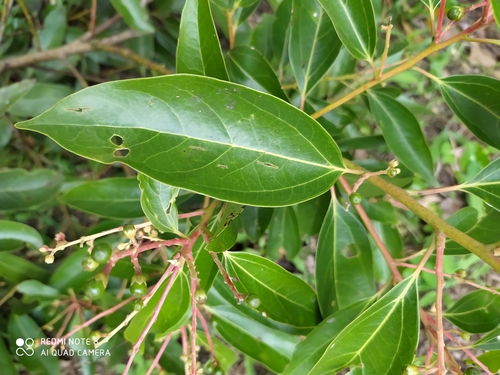
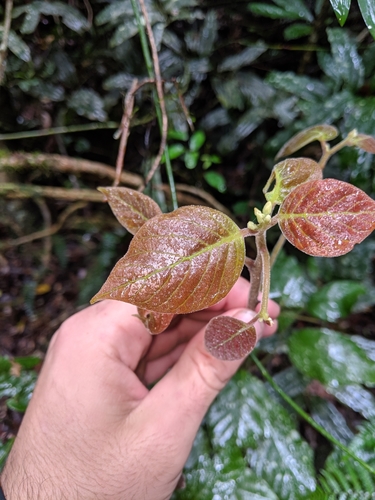
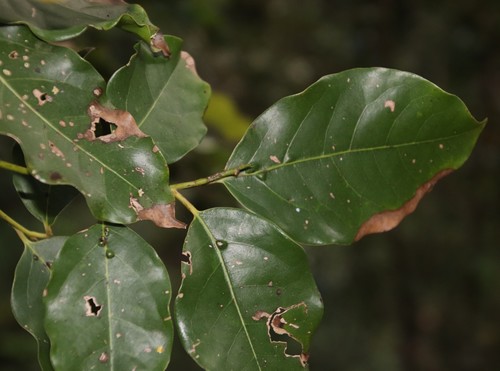
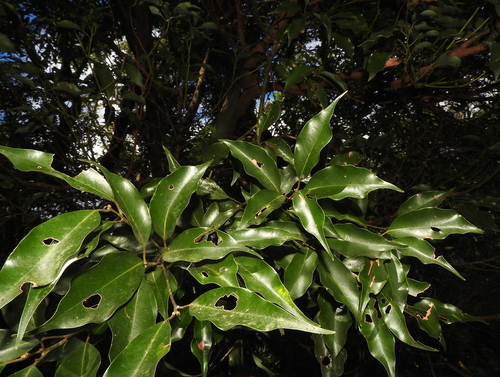
Ocotea acutifolia is a species in the genus Ocotea. Members of this genus are trees or shrubs, and some species occasionally grow adventitious roots. Their leaves are simple and alternate, and only rarely are they arranged opposite or in whorls. These are lauroid leaves, typically dark green and glossy; sometimes the leaf underside is brown, and the leaves contain fragrant oil cells. All Ocotea species native to Africa and Madagascar have bisexual flowers, which carry both male and female reproductive parts. In contrast, many American Ocotea species have unisexual flowers, which are either male or female. These apetalous flowers form small panicles. The genus produces fruits that are globose or oblong berries, 3 to 5 cm long, with a hard, fleshy texture. At the junction where the peduncle connects to the fruit, the fruit is covered by a cupule that is usually cup-shaped, and occasionally flat. This structure gives the fruit an appearance similar to an acorn. Unripe fruits are dark green, and gradually darken as they reach maturity. The cupule at the base of the berry can be more brightly colored than the fruit. Each fruit holds a single seed enclosed in a hard coat that may be slightly lignified. Most Ocotea species are distributed across tropical Americas, ranging from Mexico to northern Argentina, including the West Indies. Additional species grow in eastern Africa from South Africa to Ethiopia, in Central Africa's Gabon and Republic of the Congo, and on Madagascar and the Mascarene Islands. One species, Ocotea foetens, is native to the North Atlantic Canary Islands and Madeira. Overall, Ocotea species occur in subtropical and tropical regions, most often at higher elevations. They are characteristic plants of many tropical and subtropical montane forests, including the Araucaria moist forests, Yungas, and Talamancan montane forests in the Americas; Afromontane forests such as the Knysna-Amatole montane forests in Africa; and Laurisilva in the Macaronesian islands. They also grow in lowland forests in Madagascar and Brazil. Small-fruited Ocotea species have high ecological importance, as their fruits are a major food source for many endemic birds and mammals, especially on islands and in premontane and montane forests. Ocotea leaves are a food source for caterpillars of multiple endemic Lepidoptera species, including several species in the genus Memphis. Some Memphis caterpillars feed exclusively on the leaves of a single Ocotea species: for example, M. mora feeds only on O. cernua, and M. boisduvali feeds only on O. veraguensis. Seeds of some Ocotea species are dispersed by frugivorous birds, including toucans, three-wattled bellbirds (family Cotingidae), quetzals, and Cape parrots. Ocotea fruit is also eaten by multiple members of Columbiformes, including Columba trocaz, Delegorgue's pigeon, Bolle's pigeon (Columba bollii), African wood pigeon, and American doves. Most African Ocotea tree species are ancient paleoendemic species that were once widely distributed across the continent. This is not the pattern seen in the Americas, where 89 Ocotea species have been collected in Venezuela alone. Ocotea species can be attacked by various rot-causing root pathogens, including Loweporus inflexibilis, Phellinus apiahynus, and Phytophthora cinnamomi. Some Ocotea species are used as nesting sites by ants, which may live in leaf pockets or hollowed-out stems. These ants patrol their host plant more often in response to disturbance or the arrival of insect pests such as grasshoppers. Ocotea species produce essential oils that are rich in camphor and safrole. Timber from East African camphorwood (O. usambarensis), Peruvian rosewood (O. cernua), and Brazilian sassafras (O. odorifera) is traded internationally. In Ecuador, dried fruit cupules of ishpingo (O. quixos) are used to flavor beverages such as colada morada. Some fast-growing Ocotea tree species are commercially harvested for timber, including O. puberula, O. bullata (black or true stinkwood), and O. usambarensis. This timber is valued for its natural resistance to fungal decay. O. odorifera (Brazilian sassafras) and O. kuhlmanni are commonly used as honey plants.