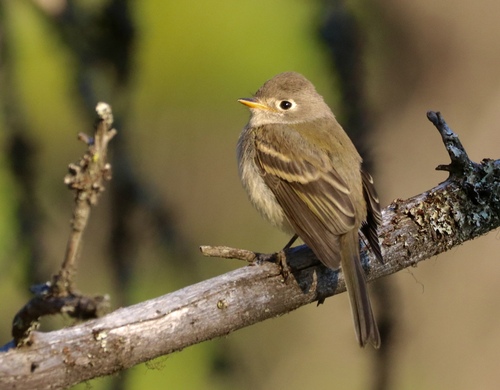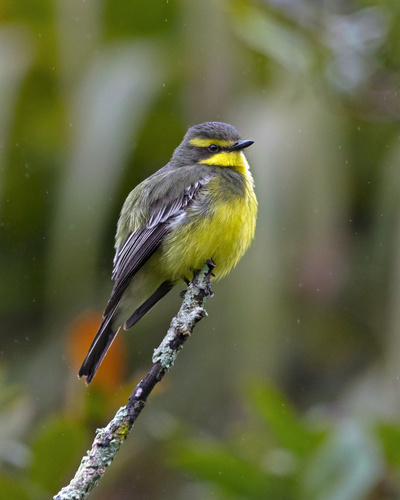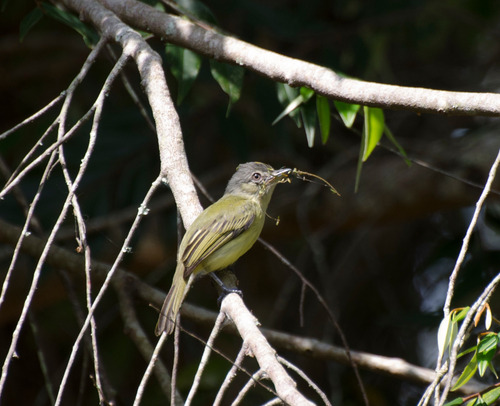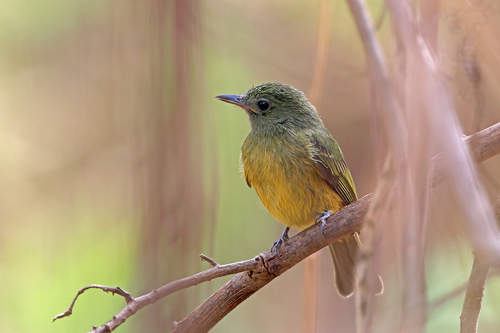
About Ochthoeca rufipectoralis (Orbigny & Lafresnaye, 1837)
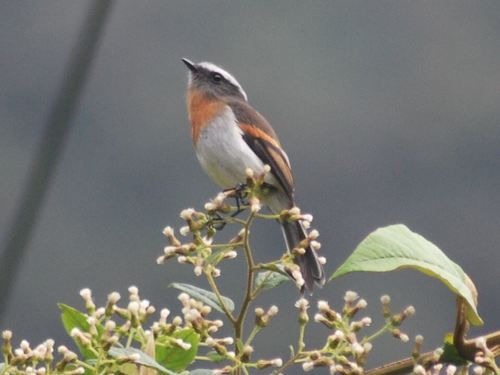
The rufous-breasted chat-tyrant, Ochthoeca rufipectoralis (Orbigny & Lafresnaye, 1837), measures 12.5 to 14 cm (4.9 to 5.5 in) long and weighs roughly 13 g (0.46 oz). Males and females share identical plumage. For the nominate subspecies O. r. rufipectoralis, adults have a sooty brown head with a white patch above the bill that extends into a long, wide white supercilium. The upperparts range from brown to sooty brown. The wings are blackish, with faint rufous or cinnamon-buff edges along the secondaries and tertials. The tail is blackish, with thin white edges on the outermost tail feathers. The chin and throat are grayish, the lower throat and breast are dark rufous-orange, and the belly is white. All currently recognized subspecies differ from the nominate subspecies and each other in the following traits: O. r. poliogastra has a crown the same brown color as the back, a wide rufous wing bar, a narrower and paler rufous-orange breast, and grayer underparts than the nominate. O. r. rubicundula is very similar to O. r. poliogastra. O. r. rufopectus is very similar to O. r. poliogastra. O. r. obfuscata has more visible pale edges on the tertials than the nominate, and one or two rufous wing bars. O. r. centralis resembles O. r. obfuscata, but has a darker breast. O. r. tectricialis is highly variable, and is intermediate between O. r. obfuscata and O. r. centralis in the area where their ranges overlap. All subspecies of the rufous-breasted chat-tyrant have a dark brown iris, a short, thin, black bill, and black legs and feet. This species is primarily an Andean bird, found on both the eastern and western slopes of the Andes, and also occurs in several smaller isolated mountain ranges, with an overall disjunct distribution. Each subspecies has its own distinct range: O. r. poliogastra is found in the Sierra Nevada de Santa Marta in northern Colombia. O. r. rubicundula lives in the Serranía del Perijá, along the border between Colombia and Venezuela. O. r. obfuscata ranges from the Central and Western Andes of Colombia, south through Ecuador into the Piura, Cajamarca, and Amazonas departments of northern Peru. O. r. rufopectus occurs in the Eastern Andes of Colombia. O. r. centralis inhabits the La Libertad, Ancash, and Huánuco departments of north-central Peru. O. r. tectricialis is found in south-central Peru, from the Pasco department to the central Cuzco department. The nominate subspecies O. r. rufipectoralis ranges from southeastern Cuzco and northern Puno departments of Peru into western Bolivia, as far south as Bolivia's western Santa Cruz Department. The rufous-breasted chat-tyrant primarily lives in temperate zone montane forest edges, cloudforest, and Polylepis woodlands. It also occurs in scrubbier, stunted forest near the tree line, particularly in Venezuela. Its elevation range varies by region: in Venezuela it occurs between 2,750 and 3,100 m (9,000 and 10,200 ft); in Colombia between 2,600 and 3,200 m (8,500 and 10,500 ft); in Ecuador it mostly lives between 2,500 and 3,300 m (8,200 and 10,800 ft); in Peru it ranges between 2,300 and 4,100 m (7,500 and 13,500 ft), though it is rare at the highest elevations of this range.