About Ochthoeca diadema (Hartlaub, 1843)
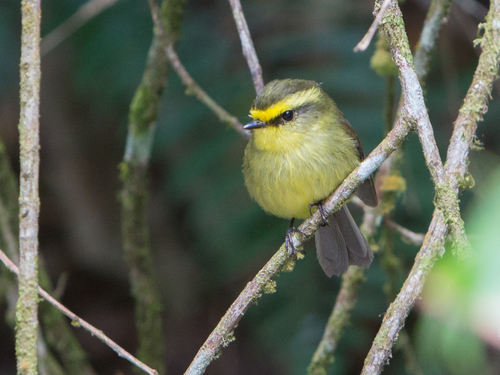
The yellow-bellied chat-tyrant, scientifically named Ochthoeca diadema (Hartlaub, 1843), is 12 to 12.5 cm (4.7 to 4.9 in) long. It has a large-headed appearance and long rictal bristles. Both sexes share identical plumage. For adults of the nominate subspecies O. d. diadema, the crown is dark olive, the lores are blackish, and a yellow patch on the forecrown extends into a supercilium that grows thinner and paler as it runs far past the eye. The rest of the face is dark olive. Upperparts range from olivaceous to brownish olive, while the wings and tail are dusky. The throat and belly are light yellow, and the breast is a more olive-yellow. Juveniles have an ochraceous tinge on the back of the supercilium, a rufous wash on the back, and an ochraceous vent. Other subspecies differ from the nominate and from each other as follows: O. d. jesupi has no visible difference from the nominate when observed in the field; O. d. rubellula has a rufescent brown back and wide rufous edges on the flight feathers; O. d. tovarensis is similar to the nominate but has brighter yellow underparts; O. d. gratiosa has dull rufous tips on upperwing coverts and rufous edges on the flight feathers. All subspecies have a dark brown iris, a black bill, and black legs and feet. The yellow-bellied chat-tyrant has a disjunct distribution, with each subspecies occupying a separate range: O. d. jesupi lives in the isolated Sierra Nevada de Santa Marta in northern Colombia; O. d. rubellula is found in the Serranía del Perijá along the Colombia-Venezuela border; O. d. tovarensis occurs in the eastern Venezuelan Coastal Range in Aragua and the Federal District; O. d. diadema ranges from the Andes of western Venezuela into Colombia's Eastern Andes; O. d. gratiosa is found from Colombia's Central and Western Andes south along the western Andean slope of Ecuador into Pichincha Province, and along the eastern slope through Ecuador into northern Peru, reaching the Marañón River valley in Piura and Cajamarca departments. This bird primarily inhabits the interior and undergrowth of humid montane forest and cloudforest in the subtropical and temperate zones. It occurs less often on forest edges along watercourses, and generally avoids bamboo stands. Its elevation range varies by region: 1,950 to 2,200 m (6,400 to 7,200 ft) in the Venezuelan Coastal Range; 2,100 to 3,050 m (6,900 and 10,000 ft) elsewhere in Venezuela; 1,800 to 3,200 m (5,900 to 10,500 ft) in Colombia; mostly 2,200 to 3,100 m (7,200 to 10,200 ft) in Ecuador; and 2,300 to 3,100 m (7,500 to 10,200 ft) in Peru.