About Ochetellus glaber (Mayr, 1862)
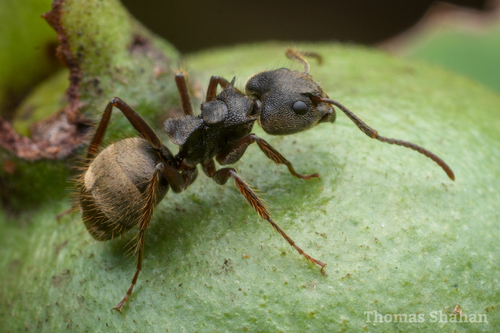
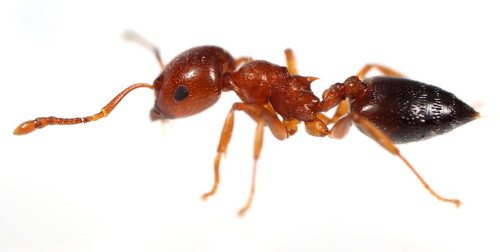
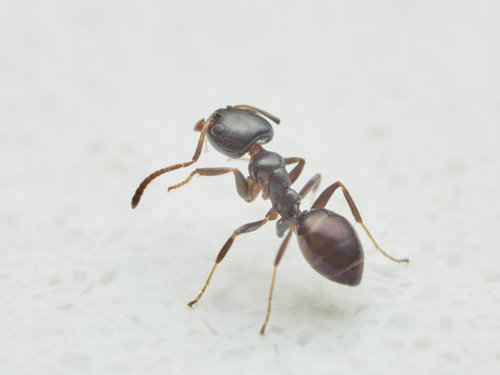
Ochetellus glaber (Mayr, 1862) is a small ant species. Worker individuals measure 2–3 mm (0.079–0.118 in) in length. Their antennae have 12 segments, with scapes that are half the length of the head. The antennal sockets and posterior clypeal margin are separated by a small distance, likely less than the minimum width of the antennal scapes. Eye size ranges from medium to large, with more than six facets (the lenses that make up an insect's compound eye). The dorsum of the mesosoma has distinct metanotal grooves and no erect hairs. The propodeum has a distinct protrusion that creates a strongly concave slope. This ant has only one segment in its waist. The upright petiole (narrow waist) is not flattened. The gaster has a ventral slit, and no constriction is visible between the third and fourth abdominal segments. Body colour ranges from brown to black. Males are smaller than workers, measuring 1.6 millimetres (0.063 in). Their body is brown, with a brownish-black back, and yellow mandibles, legs and antennae. The head and thorax are noticeably wrinkled. Queens are larger than both males and workers, measuring 5.2–5.5 millimetres (0.20–0.22 in). Young larvae of O. glaber measure 1.4 mm (0.055 in). Compared to older larvae, young larvae have stouter bodies and straighter outlines. They have 13 differentiated somites, and spinules (small spines or thorns) are more prominent at the posterior end. Body hair is extremely short, measuring 0.002–0.015mm long. Mature larvae are larger, at 3.9 mm (0.15 in), with a short and stout body. The integument (the organism's tough outer protective layer) is spinulose, bearing small spines arranged in short transverse rows on both the ventral side and posterior end. Body hair is present but sparse on the head. The mandibles have a large apical tooth. The maxillary and labial palps (sensory feeding organs) each have three sensilla (sensory organs protruding from the cuticle). Unlike larvae of other Dolichoderines, O. glaber larvae are yellow rather than white. The karyotype of O. glaber has been described: it has eight metacentric chromosomes, four submetacentric to acrocentric chromosomes, and two submetacentric chromosomes. O. glaber is distributed across many areas of Oceania. In Australia, its range extends from coastal Queensland and New South Wales to south-west Western Australia. It was introduced to New Zealand around 1927 and became well-established by the 1940s. While it has largely remained in Auckland and its surrounding suburbs, New Zealand authorities have intercepted specimens in other locations multiple times, and the species may spread to other New Zealand cities. It is considered a potential pest, though not a major household pest. Specimens have also been collected on Lord Howe Island, New Caledonia, Norfolk Island, the Solomon Islands, and the former New Hebrides. Other locations where O. glaber has been found include Réunion, India, the Philippines, China, Macao, Japan, and Sri Lanka. In India, it has been collected from the states of Haryana, Himachal Pradesh, Karnataka, Maharashtra, and Uttarakhand. In the United States, O. glaber was first recorded in Hawaii in 1977, where it originated from Australia and Japan. It is currently found on Kauai, Maui, Oahu, and the Island of Hawaii. It has also been found in Florida, where specimens were collected from a queen palm (Syagrus romanzoffiana) stump. It is an abundant but localised species in Orange County, found in dead wood or in tussocks of marsh grasses. O. glaber is an arboreal nesting species. It lives in open areas or savannah woodland, nesting under stones or old dry logs, in hollow trees, plant stems, or rotten wood. It is also often found and easily spotted in gardens. Additional habitats include mountain forests, wet forests, pastures, garden flower tubs, and dried palmetto fronds. It occurs at altitudes between 5 and 1,585 m (16 and 5,200 ft) above sea level. In human-built structures, it nests in crevices and cavities such as rockeries, paving, and brickwork, as well as in ceilings, walls, and subfloor areas. O. glaber is omnivorous, forming long trails along tree trunks to seek sweet substances like honeydew and to hunt insects. It is active both during the day and night, with increased activity on overcast days or at night, peaking in early mornings and from late evening to early night. Nocturnal activity ranges from minimal to non-existent. It consumes carcasses of dead birds, sea turtles, and parrot fish, as well as fruit fly pupae and diamondback moth larvae. It also prefers fat, grease, plants, and seeds. It often invades galleries of the Formosan subterranean termite (Coptotermes formosanus), though termite mortality rates are substantially higher when big-headed ants (Pheidole megacephala) invade termite galleries instead. O. glaber has developed associations with a range of organisms. Foraging workers often visit flowers for nectar, chiefly those of Pisonia, but also of Canavalia, Commicarpus, Ipomoea, Melanthera, Plumbago, and Scaevola. It associates with some insects, including the pineapple mealybug (Dysmicoccus brevipes) and aphids, which it brings into and tends alongside other bugs on domestic pot plants. It also associates indirectly with Ananusia australis, an encyrtid parasitoid wasp. During nuptial flight, a queen may mate with multiple males, while males only mate with a single queen, making the species monogynous. Colonies sometimes spread through "budding" (also called "satelliting" or "fractionating"), in which a subset of the colony including queens, workers, and brood (eggs, larvae, and pupae) leaves the main colony to establish a new nest at an alternative site.