About Nystalus chacuru (Vieillot, 1816)
General Body Shape
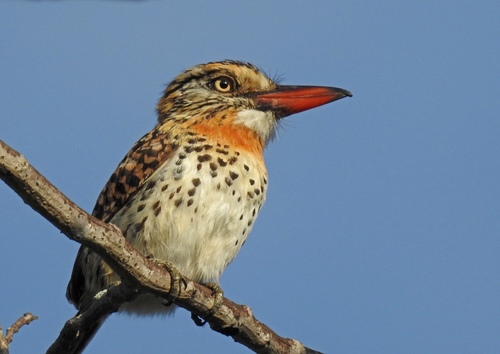
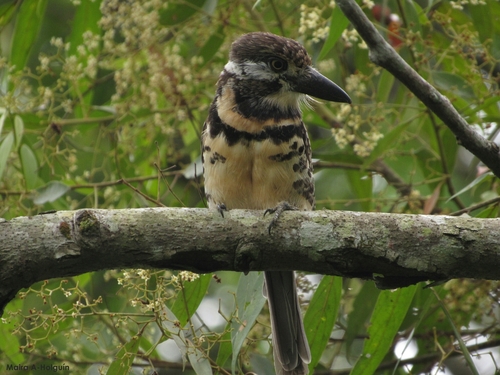
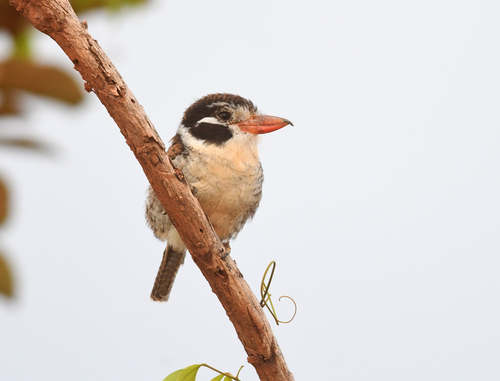
Like some other puffbirds, the white-eared puffbird (Nystalus chacuru) is a round, plump bird with a very narrow tail.
Its head is relatively large, with a dark brown barred crown, and an orange bill tipped with black.
Feeding Strategy Link
This body shape may be linked to its sit-and-wait feeding strategy for insects or other opportunistic prey.
Dorsal and Breast Markings
The bird’s back and wings are medium-brown, marked with dark rufous speckles and bars; its breast is flecked with white and black.
Neck and Collar Features
A white upper breast extends into a narrow-to-medium white collar around the neck.
Ear Patch Features
It has a distinctive medium-sized white ear patch, which gives the species its common name, and this white patch is surrounded by a dark ear patch.
Tail Structure
Its medium-sized tail is dark brown, slightly graduated, with narrow, widely spaced buffy bars and a pale tip.
Size and Weight
The white-eared puffbird measures about 21–22 cm (8.3–8.7 in) in length and weighs between 48–64 g.
Overall Distribution Range
This species occurs from eastern Peru and central Brazil south to Paraguay, Bolivia, and northeastern Argentina.
Southeastern Brazil Range
In southeastern Brazil, its range is centered on the Cerrado region, and extends along the southeast Atlantic coast from northern Bahia state south to the border of Paraná and Santa Catarina states.
Pantanal and Caatinga Range
It occupies much of the eastern and northern Pantanal, and the southern areas of the Caatinga.
Amazon Headwaters Range
The north and west portions of its range include the upstream headwaters of some Amazon Basin river systems, covering nearly all of northern Bolivia, many headwater tributaries of the Madeira River, and the extreme headwaters of the Tapajós River.
Tapajós East Range
East of the Tapajós, the range extends into the Cerrado, the upper half of the Xingu River drainage, and the entire drainage system of the Araguaia-Tocantins River, an eastward system generally considered part of the Amazon Basin.
Peru Distribution
In Peru, the species is rare but found locally; it occurs in the very western border region adjacent to Bolivia, and in some localities in north-central Peru.
Peruvian Habitat and Altitude
In this Peruvian region, it favors dry forests and scrub in parts of the Mantaro, Apurimac, and Urubamba Valleys, at altitudes between 1000 and 2200 m.
Additional Peruvian Record
It has also been recorded in the Mayo Valley.
Isolated Madeira River Location
A second separate known location is mid-river on the downstream Madeira River in Amazonas state, southern Amazon Basin.