About Nypa fruticans Wurmb
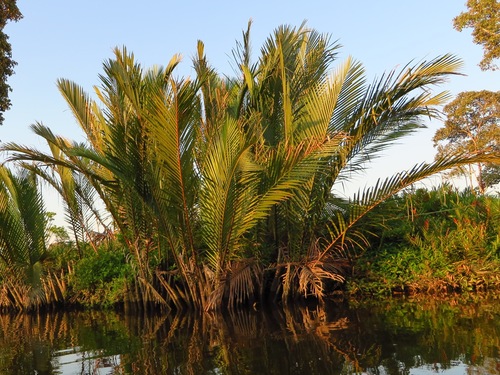
Nypa fruticans Wurmb, commonly known as nipa palm, differs from most palms in that its trunk grows underground; only its leaves and flower stalk emerge above ground. Its leaves reach up to 9 metres (30 feet) in height. The inflorescence is globular, with female flowers at the tip and catkin-like red or yellow male flowers growing on its lower branches. After flowering, it produces woody nuts arranged in a globular cluster up to 25 centimetres (10 inches) across on a single stalk. The mature fruiting cluster (infructescence) can weigh up to 30 kg (4 st 10 lb). The fruits are globular and made up of multiple seed segments; each seed has a fibrous husk surrounding its endosperm that allows the seed to float. The stalk droops as the fruits mature. When fully ripe, seeds separate from the cluster and float away with the tide, and they will occasionally germinate while still carried by water. Nipa palms grow in soft mud and slow-moving tidal and river waters that carry nutrients. They can be found as far inland as tides can carry their floating seeds. They are common along coasts and rivers that drain into the Indian and Pacific Oceans, ranging from India to the Pacific Islands. This palm can survive occasional short-term drying of its habitat. Though it is often called "mangrove palm" and is common in coastal areas, it is only moderately salt tolerant, and is damaged when exposed to pure seawater; it prefers the brackish water of estuaries. It is considered native to Hainan (China), the Ryukyu Islands, Bangladesh, the Indian subcontinent, Sri Lanka, the Andaman and Nicobar Islands, Vietnam, Laos, the Malay Peninsula, northern Singapore, all of Borneo, Java, Maluku, the Philippines, Sulawesi, Sumatra, the Bismarck Archipelago, New Guinea, the Solomon Islands, the Caroline Islands, and Queensland and the Northern Territory (Australia). It has reportedly become naturalized in Nigeria, the Society Islands of French Polynesia, the Mariana Islands, Panama, and Trinidad. Japan's Iriomote Island and neighboring Uchibanari Island mark the northernmost limit of its natural distribution. Ecologically, long-tailed macaques (Macaca fascicularis) are known to eat nipa palm fruits. Proboscis monkeys in the Padas Damit Forest Reserve have been observed eating nipa palm inflorescences. Bornean orangutans eat nipa palm hearts and shoots. Two fungal species, Tirisporella beccariana and Phomatospora nypae, have been found growing on nipa palms, with Phomatospora nypae recorded on nipa palms in Malaysia. The long, feathery leaves of the nipa palm are used by local communities as thatch roofing for houses and dwellings. Leaves are also used for many types of basketry and other thatched products. Because their stems are buoyant, large stems are used to train swimmers in Burma. On the islands of Roti and Savu, nipa palm sap is fed to pigs during the dry season, which is said to give the pork a sweet flavor. Young leaves are dried, bleached, and cut to wrap smoking tobacco, a practice that also occurs in Sumatra. In Cambodia, this palm is called ចាក cha:k, and its leaves are used for roofing. Thatching with nipa palm leaves is common across many areas of Papua New Guinea; in some coastal regions, the leaf rachis is used for house walls, leaflets are used for ornaments, and leaf epidermises are used as cigarette paper. Nipa palm leaves are also used for handicrafts across Southeast Asia, such as making tempok among Orang Asli tribes. For food and beverage use, the young flower stalk and hard seeds of nipa palm are edible and provide hydration. In the Philippines and Malaysia, the inflorescence can be tapped to collect sweet, edible sap, which is used to make a local alcoholic beverage called tuba, bahal, or tuak. A fruit cluster is ready for tapping when its unripe fruits are at peak sweetness. The cluster is cut from the stalk about six inches down, and mud is rubbed onto the cut stalk to encourage sap flow. Sap starts flowing immediately if the fruit was correctly judged to be mature. A bamboo tube or bottle is fitted over the cut stalk to collect sap, which is gathered twice daily; after each collection, a 0.5 centimeter slice is cut from the end of the stalk to keep it from getting clogged with hardened sap. Each stalk produces sap for around 30 days, and nipa palms flower continuously year-round, so sap is available continuously. Tuba can be stored in tapayan (balloon-shaped earthenware vases) for several weeks to make a type of vinegar called sukang paombong in the Philippines and cuka nipah in Malaysia. Tuba can also be distilled to make arrack, known locally as lambanog in Filipino and arak or arak nipah in Indonesian. Young nipa palm shoots are edible, and flower petals can be infused to make an aromatic herbal tisane. Attap chee (Chinese: 亞答子; pinyin: yà dá zǐ; chee means "seed" in several Chinese dialects) is the name for the palm's immature fruits, which are sweet, translucent, gelatinous balls used as a dessert ingredient in Thailand, Malaysia, the Philippines, and Singapore, and are a byproduct of the sap harvesting process. In Indonesia, especially on Java and Bali, nipa palm sap is used to make a type of jaggery called gula nipah; in Sarawak, this product is called gula apong. In Thailand, nipa palm leaves are used for desserts. In Cambodia, nipa palm leaves are used to wrap cakes such as num katâm, and the flowers are sometimes used to make sugar, vinegar, and alcohol.