About Nymphalis xanthomelas (Denis & Schiffermüller), 1775
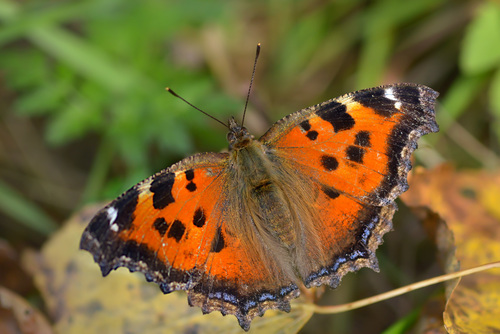
The upper side of the wings of Nymphalis xanthomelas is a rich orange-yellow. On the forewing, the basal half of the costal margin is dusky black, flecked with brown. The forewing has two oval black spots inside the cell, a quadrate subcostal black patch just beyond the discocellulars, a second more oblique, irregular black patch beyond that, and three large oval discal black spots, with a smaller dusky patch located beyond the lowest of these spots. The hindwing is mostly uniform, with one large subcostal black patch. Both forewings and hindwings have a shared sinuous transverse subterminal black band, and a terminal dusky band flecked with golden brown. On the hindwing, the black subterminal band has an outer border of blue lunules, which is further margined outward by a slender black line. Just below the costa of the forewing, between the black patches beyond the cell and between the outer black patch and the subterminal band, the area is prominently pale yellow. In female individuals, an incomplete series of yellow lunules also borders the outer side of the subterminal black band. The underside of the wings is dull ochraceous brown, with the basal half of both forewings and hindwings and a broad terminal margin a darker shade of brown. The entire surface of the wings is thickly covered with slender transverse dark brown striae. Irregular cell marks are present on the forewing, and both wings have a transverse, highly sinuous subterminal band of dark blue lunules, which are outlined by slender black lines on both sides. The bases of the wings are covered in long, stiff black hairs that have blunt apices; on the forewing, these hairs extend along the basal half of the costal margin and project outwards beyond the margin itself. The antennae, head, and thorax are very dark brown, while the abdomen is fulvous, or tawny. The underside of the body is very hairy; the palpi, thorax, and abdomen are dark brown, with the abdomen becoming paler toward its apex. This species has a wingspan ranging from 63 to 68 mm. Its known distribution includes Eastern Europe, the Himalayan region from Kashmir to Mussoorie, China, and Japan. In 1953, British entomologist Christine Foord recorded this species at Shipbourne in Kent, Southeast England.