About Nymphalis polychloros (Linnaeus, 1758)
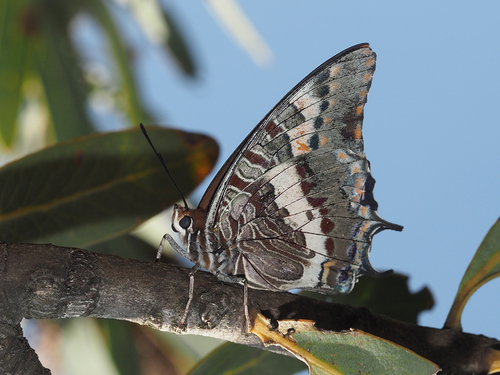
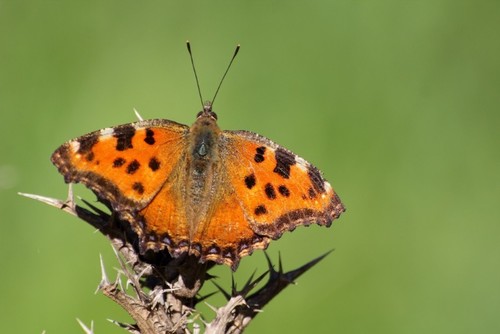
Nymphalis polychloros, commonly known as the large tortoiseshell, exhibits size differences between sexes: males have a wingspan of 68–72 millimetres (2.7–2.8 inches), while females have a wingspan of 72–75 millimetres (2.8–3.0 inches). These are medium to large butterflies with orange to red wings marked with black and yellow patches. Both the forewings and hindwings have yellowish submarginal lunules. Behind these lunules sits a black band that is also made up of lunules; on the hindwing, this band holds small blue spots. The underside of the wings is smoky brown with darker shading and fine black transverse markings. This species shows no sexual dimorphism.
Nymphalis polychloros strongly resembles the small tortoiseshell (Aglais urticae), but it is more closely related to the Camberwell beauty and Nymphalis xanthomelas. It can be distinguished from the small tortoiseshell by its larger size (the small tortoiseshell only has a 45–62 mm wingspan), the more orange base colour of the upper wing surface, and the orange base of its hindwings. Its forewing is orange-brown, with 3 black blotches along the costal edge, 3 large black spots in the posterior disc, and a narrow blackish terminal band. These markings are less bright than those of A. urticae, and N. polychloros lacks the apical white spot and marginal blue dots found on the small tortoiseshell.
When compared to the yellow-legged tortoiseshell (Nymphalis xanthomelas), N. polychloros has yellower spaces between the black blotches on the costal edge of its forewings, and its dark marginal band is narrower. The most reliable identifying characteristic is the dark hair covering its tarsi; the tarsal hairs of the yellow-legged tortoiseshell are light-coloured.
This species is distributed across North Africa, southern and central Europe, Turkey, southern Russia, the central and southern Urals, Kazakhstan, and the Himalayas. In Central Europe, it occurs only in warmer regions and has become generally rare, but it remains common in the Mediterranean and the southern Alps. It typically inhabits sparse forests, forest edges, dry shrubbery, and orchards, especially woodlands containing sallows (willows).
In Britain, Nymphalis polychloros is currently extremely rare, though it was once widespread across England and Wales. Until recently, most individuals recorded in Britain were thought to be from captive-bred releases. However, its recent resurgence suggests that at least some of these recent sightings are of naturally occurring butterflies. There is ongoing evidence that the large tortoiseshell is recolonising southern England, with multiple recorded breeding events across various southern English counties, most heavily concentrated in Kent and Sussex.